

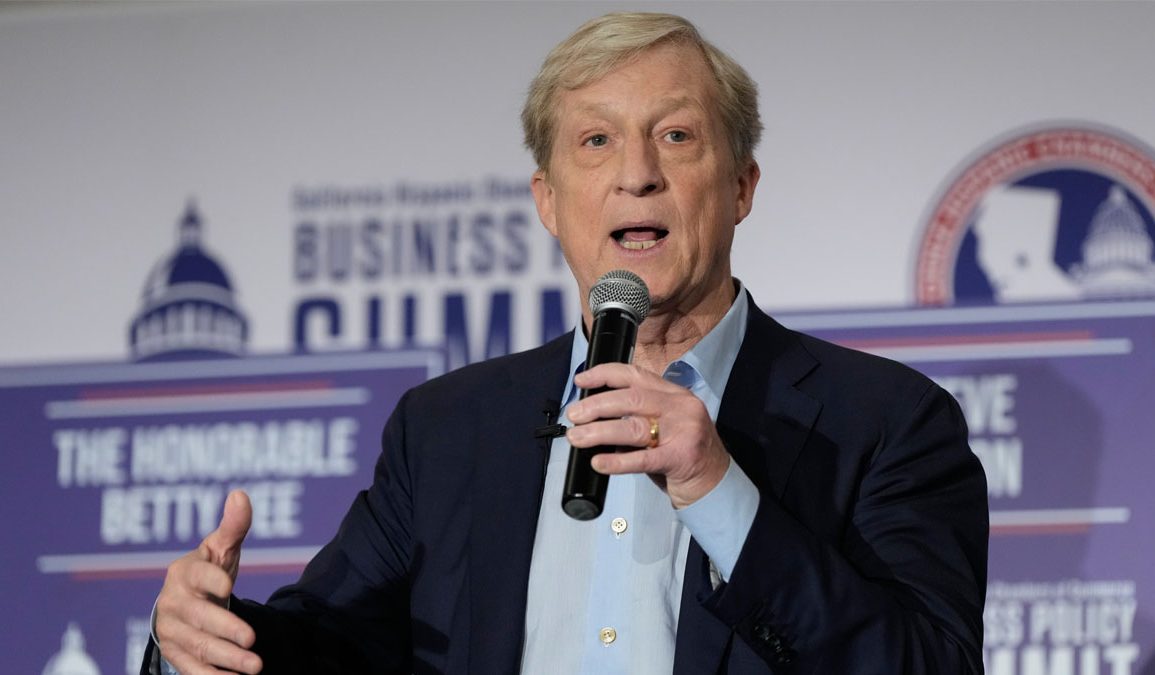
The race for California governor has taken a dramatic turn, and at the center of it is Tom Steyer, a billionaire who is outspending every other candidate by a staggering margin. His campaign is not just expensive. It is dominating the political landscape in a way rarely seen in modern elections.
While other candidates fight for attention, Steyer is flooding the state with ads, raising serious questions about whether money alone can buy the governorship in the nation’s largest state.
Steyer is a hedge fund manager turned political activist who has never held elected office. He built his fortune through finance, most notably at Farallon Capital, before transitioning into political advocacy and environmental causes.
Now he is running for governor of California in a crowded and unsettled field. The primary election is set for June 2, with the top two finishers advancing to the general election in November. California’s system means party does not matter in the primary. Only vote totals do.
That structure has created a chaotic race with no clear frontrunner, opening the door for someone with overwhelming resources to dominate the conversation.
A Spending Gap Unlike Anything Else in the Race
Steyer’s defining advantage is money, and not just a little more than his rivals. According to ad tracking data, he has spent or reserved more than $115 million on advertising alone. That is nearly 30 times more than his closest Democratic competitor.
Even more striking, his spending exceeds the combined advertising efforts of many of his opponents and supporting groups. If he continues at this pace, he could surpass the all-time record set by Meg Whitman, who spent $178.5 million in 2010.
Steyer’s ads are everywhere, especially in major markets like Los Angeles. Voters report seeing them constantly, making his name one of the most recognizable in the race.
Critics are blunt about what this means. “Billionaire money is flooding our state in an attempt to buy this election,” warned Katie Porter.
The Blitz Explained
Unlike most candidates, Steyer is largely self-funding his campaign. His personal fortune is the engine behind the ad blitz, allowing him to bypass traditional fundraising limitations.
This financial independence gives him unmatched flexibility, but it also feeds a narrative that he is trying to purchase political power rather than earn it through voter support.
That perception is not new. During his 2020 presidential run, Steyer spent heavily but failed to gain traction. When asked at the time about buying elections, he responded, “I don’t think that’s possible. I’m never going to apologize for succeeding in business.”
Now, that same question is being asked again, but at a much larger scale.
The Collapse of Eric Swalwell and a Sudden Opening
The race shifted dramatically after the sudden exit of Eric Swalwell, who had been a leading Democratic contender.
Swalwell’s campaign collapsed following sexual assault allegations that he denies. His departure left a vacuum among Democratic voters and endorsements, many of which are now up for grabs.
Steyer has moved quickly to capitalize. He picked up key backing, including support from the influential California Teachers Association, which had previously supported Swalwell.
The result is a surge in attention and momentum for Steyer, even if his polling numbers have not fully broken away from the pack.
Still No Clear Leader
Despite his massive spending, Steyer has not locked down the race. Polling shows a tight cluster of candidates, including Porter and Republican contenders like Steve Hilton and Chad Bianco.
Veteran strategist Bill Carrick summed up the situation bluntly. “There is something inherently holding Steyer back.”
Even after tens of millions of dollars in ads, his support has only climbed into the low double digits. That raises a critical question. If early spending does not move voters, will more spending make any difference?
History suggests caution. Billionaires like Michael Bloomberg and Rick Caruso spent heavily but failed to win.
Facing Republicans in a Reshaped Race
On the Republican side, the race has also shifted. Donald Trump endorsed Hilton, giving him a boost over Bianco and reducing the chance that Republicans split their vote evenly.
That matters because California’s system could allow two Republicans to advance if Democrats divide their support too widely. Trump’s endorsement makes that outcome less likely, increasing the chances that at least one Democrat, possibly Steyer, reaches the general election.
Still, Hilton remains competitive and has already attacked Steyer’s policies as extreme.
Steyer’s Policy Positions and Growing Criticism
Steyer is running as a strongly progressive candidate, and some of his positions have drawn sharp criticism.
He has called for abolishing Immigration and Customs Enforcement, saying, “ICE is a criminal organization.” He has also proposed prosecuting federal agents and leadership, a stance that opponents have labeled dangerous.
Hilton called the proposal “far-left extremism,” warning it could put law enforcement at risk.
Steyer has also backed policies such as a wealth tax, aggressive environmental regulation, and new fees on artificial intelligence companies. He has argued that “we are going to charge a fee on every calculation done by artificial intelligence companies.”
These positions energize his base but may limit his appeal to broader voters.
At the same time, critics point to contradictions in his past, including investments tied to private prison companies involved in immigration detention. Opponents have used this to question his credibility.
Can Money Overcome Weak Enthusiasm
Despite his financial dominance, Steyer faces a fundamental problem. Voters do not appear deeply enthusiastic about any candidate in the race.
Analysts describe the campaign as stagnant, with no candidate capturing widespread excitement. In that environment, Steyer’s strategy is clear. If voters do not feel strongly, they may default to the name they recognize most.
That plays directly to his strength.
But there is also a risk. Constant advertising can backfire. Some strategists warn that voters may already be tiring of his presence, seeing his ads “every three minutes.”
The California governor’s race is shaping up as a test of how far money can go in modern politics.
Steyer has built a campaign machine powered by personal wealth, dominating the airwaves and forcing every other candidate into his shadow. Yet he remains vulnerable, facing skepticism from voters, criticism from rivals, and the limits of what spending can achieve.
He may be closer than ever to winning elected office. But the same question continues to hang over his campaign.
Can a billionaire buy the governorship in California, or will voters decide that recognition is not the same as support?
NP Editor: What a blow to his ego if he spends all of this money and then fails. But it looks like he is failing…