


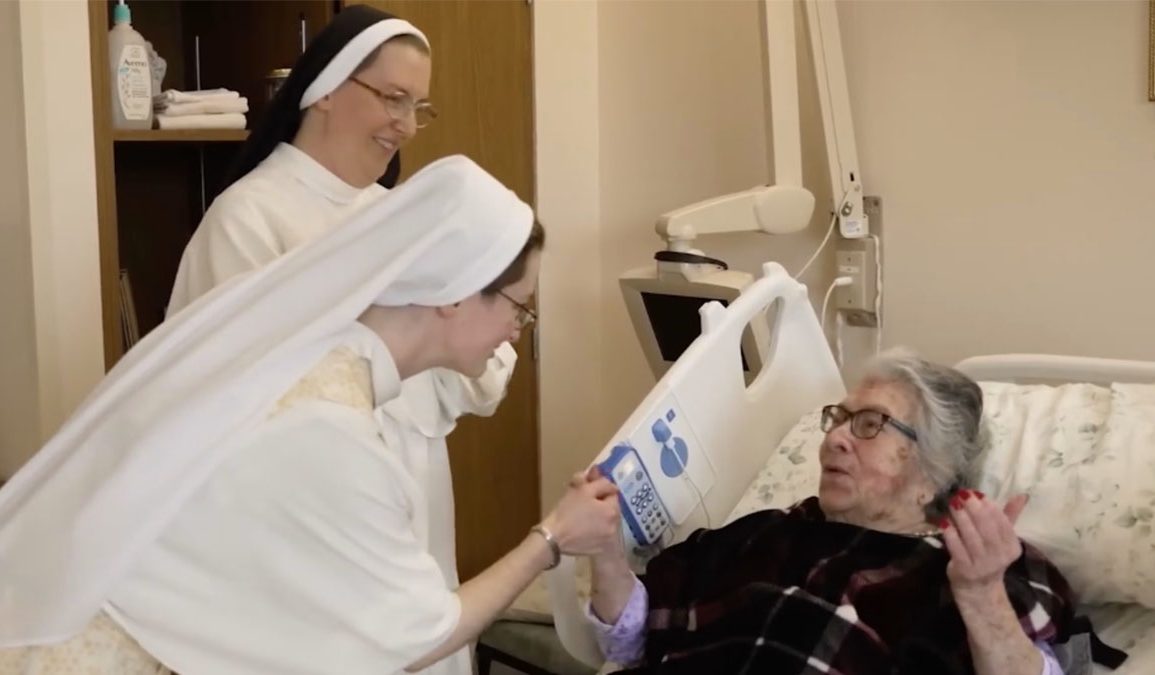
For more than a century, a quiet group of Catholic nuns has carried out a mission few others are willing to take on. They care for the poorest of the poor as they die, offering dignity, comfort, and compassion in their final days. Now, these same nuns are facing the possibility of fines, loss of their license, and even jail time, not because of complaints or misconduct, but because they refuse to violate their religious beliefs.
A Mission Rooted in Faith and Sacrifice
The Dominican Sisters of Hawthorne operate Rosary Hill Home, a small, 42-bed hospice facility in New York that provides free care to terminal cancer patients. Their work is entirely charitable. They do not accept insurance, government funding, or payment from patients or families.
Mother Marie Edward described their mission simply: “We are consecrated religious Sisters and have one mission. It is to provide comfort and skilled care to persons dying of cancer who cannot afford nursing care.”
Their work is not just medical. It is spiritual. The sisters believe they are called to treat every patient as if they were Christ himself. Their care is grounded in prayer, faith, and a deep commitment to human dignity.
“We do this without discriminating on the basis of race, religion, or sex,” Mother Marie Edward explained. “We do it because Jesus taught us that, when the least among us are sick, we should care for them.”
For nearly 125 years, they have done exactly that, quietly and without controversy.
The Law That Sparked the Conflict
That changed with the passage of a New York law signed on November 30, 2023. Known as the long-term care residents’ bill of rights for LGBTQ individuals and people living with HIV, the law requires nursing homes to follow strict gender identity rules.
Under the law, facilities must assign rooms based on gender identity rather than biological sex, allow access to bathrooms accordingly, use preferred pronouns, and permit various forms of identity expression. Staff must also undergo training aligned with the state’s gender ideology and publicly post notices confirming compliance.
Failure to comply carries steep consequences. Facilities can face fines of up to $2,000 per violation, increasing to $5,000. More severe penalties include forced compliance orders, loss of licensing, and even up to one year in prison, along with fines reaching $10,000.
For the Dominican Sisters, these requirements are not just administrative. They strike at the core of their beliefs.
“New York’s gender ideology mandates not only violate our Catholic values, they threaten our existence,” Mother Marie Edward said. “This is why we were forced to go to court.”
How the Sisters Have Cared for Patients
The sisters have always treated every patient with compassion and dignity, regardless of background or belief. They accept individuals from all walks of life and provide care without discrimination.
At the same time, their practices reflect their religious convictions. Patients are housed based on biological sex, with men and women separated, sometimes even by floor. This approach has been in place for decades without complaint.
In fact, during a four-year reporting period from 2022 to 2026, the New York State Department of Health recorded zero complaints against Rosary Hill Home. By contrast, more than 55,000 complaints were filed against other nursing homes during the same time.
The sisters argue that their system works because it respects both dignity and order, while remaining faithful to their beliefs.
“We have never had complaints,” Mother Marie Edward stated. “We cannot implement New York’s mandate without violating our Catholic faith.”
Why They Refuse to Comply
At the heart of the conflict is a fundamental disagreement about truth and identity. The Catholic Church teaches that biological sex is not changeable and is inseparable from gender. While it calls for compassion toward all individuals, it does not accept the idea that a person can change their sex.
Mother Marie Edward was clear about this point. “Christ is the way, the truth, and the life. And if he’s the truth, then we cannot practice what we do, incorporating something that is an untruth.”
She added, “It is an untruth to say that a male should go into a female patient’s room. You’re just trying to contort things.”
For the sisters, complying with the law would mean affirming something they believe is false. It would also require them to speak and act in ways that contradict their faith.
Their lawsuit argues that this violates both their freedom of speech and their free exercise of religion under the First Amendment.
“The implications are so much greater than whether to utter the words ‘he’ or ‘she,’” the lawsuit states. “To demand that a Catholic deny another’s sex is to require him or her to affirm another religious worldview.”
The Legal Battle Begins
The sisters have filed a lawsuit in federal court against New York officials, including the governor and members of the state health department. They argue that the law is unconstitutional and unfairly targets their religious practices.
Their legal team also points out what they see as unequal treatment under the law. Certain facilities, such as those run by the Church of Christ, Scientist, appear to be exempt due to their reliance on prayer for healing. The sisters argue that this creates a double standard that disadvantages Catholic institutions.
Their attorney, Martin Nussbaum, described the situation as unnecessary and unjust.
“This law imposed on the Dominican Hawthorne Sisters is a form of gender ideology virtue signaling,” he said. “It’s the state requiring these holy nuns to bend the knee to an ideology contrary to their faith.”
He emphasized that the sisters do not want a fight. “They want to focus on their ministry,” he said.
A Test of Faith and the Future
Despite the legal pressure and the possibility of severe penalties, the sisters remain resolute. Their faith, they say, will guide them through whatever comes next.
“I’m not really worried,” Mother Marie Edward said. “I know the Lord is going to take care of us.”
For now, the future of Rosary Hill Home hangs in the balance. A ministry that has quietly served the dying for over a century is now at the center of a national debate.
At its core, this case is not just about policy or procedure. It is about whether a group of women who have dedicated their lives to caring for the most vulnerable can continue to do so without being forced to abandon the beliefs that define their mission.