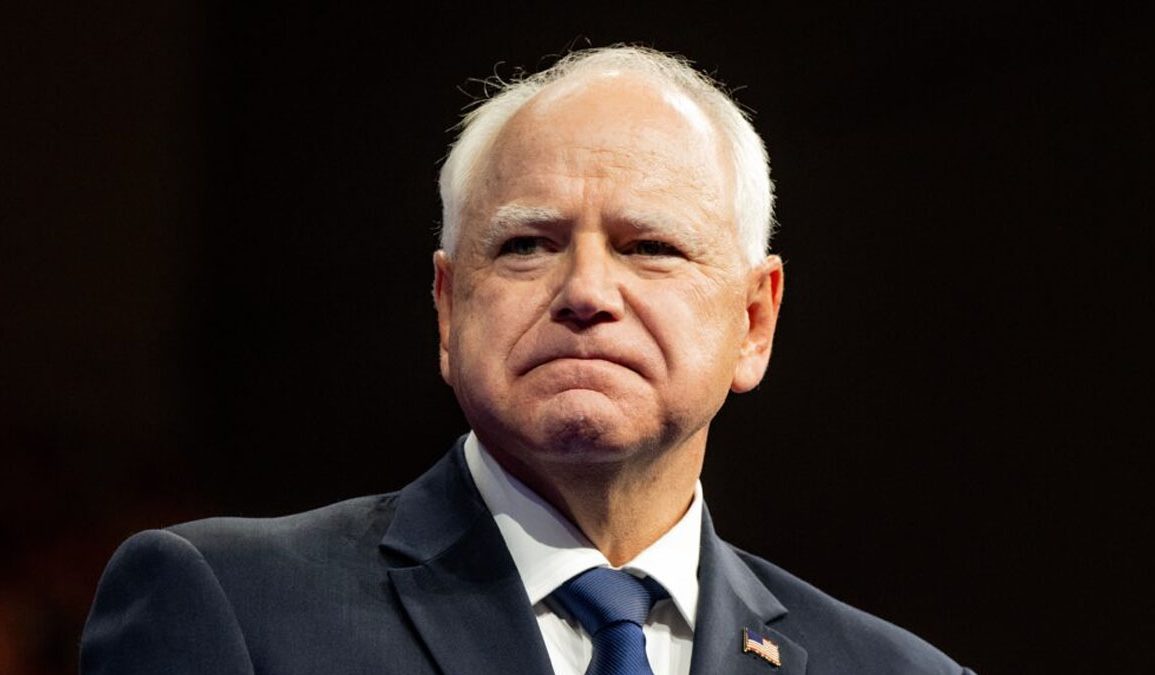
Minnesota Governor Tim Walz is out of the 2026 governor’s race, but his problems and his party’s problems are not going anywhere. After years of growing fraud scandals in social services programs, collapsing approval ratings, and heavy pressure from both Republicans and Democrats, Walz suddenly announced that he will not seek a historic third term.
He tried to frame the move as an act of duty, saying, “I came to the conclusion that I can’t give a political campaign my all. Every minute I spend defending my own political interests would be a minute I can’t spend defending the people of Minnesota against the criminals who prey on our generosity and the cynics who prey on our differences.”
But critics inside and outside his party see something very different. They see a governor who allowed one of the biggest fraud scandals in modern Minnesota history to explode on his watch, ignored warnings, and is now walking away just as federal prosecutors and the Justice Department deepen their investigations. One conservative commentator summed it up bluntly: “Tim Walz is going away, but the Democratic Party’s Tim Walz crisis isn’t,” warning that “staying out of jail will be challenging enough for him over the next few months.”
At the same time, Senator Amy Klobuchar is weighing a run for governor. In a party that has leaned into some of its worst instincts, she is widely viewed as one of the few serious and competent Democrats, and possibly the best person left to salvage the situation.
Tim Walz, 61, built his career as a public school teacher, football coach, and then congressman before becoming governor. He sold himself as a middle America Democrat who could connect with rural, white, and working class voters while pushing a progressive agenda. He rode that image all the way to the national stage as Kamala Harris’ vice presidential running mate in 2024.
In office, Walz signed sweeping liberal policies. Under his leadership, Minnesota eliminated nearly all past abortion restrictions, protected gender affirming care for youth, legalized recreational marijuana, created free school meals for all students, and launched a paid family and medical leave program. Democrats praised him as “a national leader in fighting for the middle class,” while party officials like Democratic National Committee chair Ken Martin said he “entered public life for the right reasons and never lost sight of them.”
But the image of the competent, normal Midwestern Democrat was hiding some serious failures. Federal prosecutors now say fraud in social services and related programs may reach up to 9 billion dollars. The biggest piece is the Feeding Our Future scandal, where hundreds of millions in pandemic food aid meant for children were stolen. At least dozens of people have been indicted and many convicted. There are also fresh allegations of fraud in child care programs, including Somali run day care centers that receive government aid.
Republicans argue this did not come out of nowhere. Whistleblowers say they tried to raise the alarm early and were ignored. A Minnesota fraud committee chair accused Walz of having “turned a blind eye” to warnings for years. As one Republican lawmaker, Harry Niska, put it, “Minnesota’s fraud epidemic extends well beyond any one individual. It is the result of nearly two decades of Democrat governors, backed by their legislative allies, creating a culture of complacency that has cost Minnesotans and their families billions of dollars.”
In public, Democratic leaders tried to praise Walz as he backed away. Klobuchar called him “a true public servant” who made “the difficult decision to focus on his job and the challenges facing our state rather than campaigning and running for re-election,” and said “he has always dedicated his career to delivering for Minnesota.” Ken Martin added that Walz’s choice was “entirely consistent with who Tim is” and insisted that he has always believed leadership “isn’t about preserving your own power, it’s about using it to make a difference for as many people as possible.”
Behind the scenes, the picture was much less flattering. One senior Minnesota Democrat admitted, “Many Democrats don’t want him to run, including me.” That lawmaker said, “He is certainly not corrupt, but he has not handled the fraud problem well and we worry about his electability.” Another analysis bluntly noted that Walz was beginning to look like a “local version of Joseph R. Biden Jr.” with voters, someone who might overstay his welcome and drag the rest of the ticket down.
Democrats had won every statewide office in Minnesota since 2006, but the fraud investigations and Walz’s sagging approval ratings had put that record in danger. Even Democratic strategists feared that his presence on the ballot would hurt other candidates in November.
Walt’s Daughter Speaks for Him
Walz’s daughter, Hope, added an emotional layer to the story. In a podcast interview, she said the decision was made over the winter holidays as pressure and hostility ramped up. She explained, “I think just with things rapidly changing in the past, you know, month or so, I think my dad kind of started questioning it.”
She described how social media attacks on her and her brother intensified. “When things started getting really intense for me, like on my social media, and then people even saying things like to Gus and stuff, I think that’s when he was really like, OK, like I need to evaluate what’s best for the state, and then I need evaluate what’s best for my family.” She said the last few weeks had been “really intense,” and the decision not to run again became “a natural conclusion.”
She also argued that her father believed dropping out would remove a target from Minnesota itself. In her words, “I think he believes if he’s not in the race, there’s nothing, they [Republicans] have nothing else because he has that, you know, national profile.” She claimed, “Trump just hates him for some reason. I think it’s because he’s everything Trump will never be.”
From her point of view, Walz left to protect both the state and his family. From a harder political perspective, his exit also conveniently takes him off the ballot at the very moment the investigations that began under his watch are heating up.
Republicans And Conservatives See A Symbol Of Democratic Failure
Republicans are not letting Walz’s retreat close the book. They are using him as proof of what they say is a deeper Democratic culture of incompetence and ideological blindness. The Republican Governors Association declared, “After presiding over one of the biggest fraud scandals in history it’s no wonder that Tim Walz is being forced to drop his re-election bid. Walz’s failed leadership is emblematic of Minnesota Democrats’ agenda and whoever Democrats choose to replace Walz with at the top of the ticket will need to defend years of mismanagement and misplaced priorities.”
A conservative columnist went even further. He wrote that Walz was supposed to fix the party’s image, but “it turns out what passes for normal in the party today is deep incompetence, corruption and worse.” He argued that Walz was never truly a middle American Democrat at all, just “a bland-looking white guy whose politics were as far-out as those of anyone else in his party.”
The same writer suggested that Walz’s problems could open up Minnesota in future presidential races, saying his disgrace might help move the state into the Republican column. He pointed to the “jaw-dropping scale of the Somali scandal” and claimed that even some Somali American voters have become less loyal to Democrats.
On the right, there is also a sense of personal victory. Nick Shirley, the conservative influencer whose viral video about alleged fraud in Somali run day care centers helped reignite the scandal, crowed on social media, “I ENDED TIM WALZ.” House Republicans are also talking as if Walz is running out of room to maneuver. One prominent critic, James Comer, warned that the “walls are caving in” as the fraud probes widen.
Walz’s fall has triggered a larger debate about what his party really stands for in Minnesota. Republicans say the fraud epidemic is the direct result of a Democratic culture that values identity politics and political alliances over basic accountability. As Harry Niska argued, it is not just about Walz, but about “nearly two decades of Democrat governors” and a “culture of complacency” that cost taxpayers billions.
Even some Democratic voters are starting to question whether the “farmer” and “labor” pieces of the Democratic Farmer Labor label have been sacrificed to national ideological causes. When fraud thrives in programs meant to serve the poor, and when warnings are ignored because the accused belong to a favored political community, many ordinary Minnesotans see that as both moral and managerial failure.
The Justice Department And The Threat That Still Hangs Over Walz
Walz has tried to portray his decision as a way of focusing on cleaning up the mess, but the federal government is not exactly backing off. Federal prosecutors have already charged dozens of people, and they estimate that across more than a dozen programs, the total stolen could surpass 9 billion dollars.
Dropping out of the race does not shield him from legal risk. Critics note that the Justice Department and federal prosecutors will continue digging through years of records, contracts, warnings, and internal communications. If investigators decide that state officials ignored red flags or looked the other way because of political pressure, the focus could shift from only the fraudsters who stole the money to the leaders who failed to stop them.
That is why some observers say that for Walz “staying out of jail will be challenging enough” now that the scandal has blown open. Even if he is never charged, he remains at the center of a massive federal investigation. Stepping out of the campaign removes political stress, but it does not remove the Justice Department’s interest. In that sense, he may have tried to escape the voters, but he has not escaped the investigators.
Amy Klobuchar: The Competent Alternative
In the middle of this mess, Amy Klobuchar stands out as one of the few Democrats who still appears serious, capable, and grounded in reality. A former state prosecutor and four term senator, she has consistently outperformed other Democrats in Minnesota elections, winning each Senate race by at least 16 percentage points in a state where contests often run close.
Walz and Klobuchar met the day before his announcement. According to people familiar with the meeting, he told her he planned to step aside and suggested she run for governor. She replied that she would consider it. That was enough for him to move forward with his public exit, knowing that someone with real credibility might be ready to take his place.
Klobuchar is not a flashy progressive star. Instead, she has built a reputation for doing the work, cutting deals, and understanding how government actually runs. Compared to Walz’s record of overseeing huge fraud scandals, she looks like one of the few adults left in the Democratic room. If she runs, she would be the Democrats’ best chance to prove that competence still exists inside their party.
Her entry would also reshape national politics. If she became governor, Minnesota law would allow the governor to appoint a temporary replacement to her Senate seat until a special election. That could create another high stakes race and another opening for Republicans. Yet many Democrats would still gladly make that trade if it means getting someone trustworthy in the governor’s office.
Tim Walz’s decision to quit the governor’s race is more than a personal retreat. It is a confession that his administration’s scandals and failures have become too big to manage while also asking voters for a third term. It is also an indictment of a Democratic Party in Minnesota that trusted him, followed him, and ignored warning signs for far too long.
The investigations will continue. Federal prosecutors and the Justice Department are not done. The fraud cases will move forward. The question now is whether Minnesota Democrats can find a leader who is not weighed down by incompetence and scandal.
Amy Klobuchar may be that rare figure, one of the few Democrats who still seems serious, disciplined, and capable of running a state without letting billions in taxpayer dollars vanish into fraud. Walz’s exit proves that the old approach has failed. What Minnesota does next will show whether the party has learned anything from the mess he leaves behind.
NP Editor: Minnesota desperately needs a cleanup crew, Klobuchar may be the ONLY one who can fix this.