

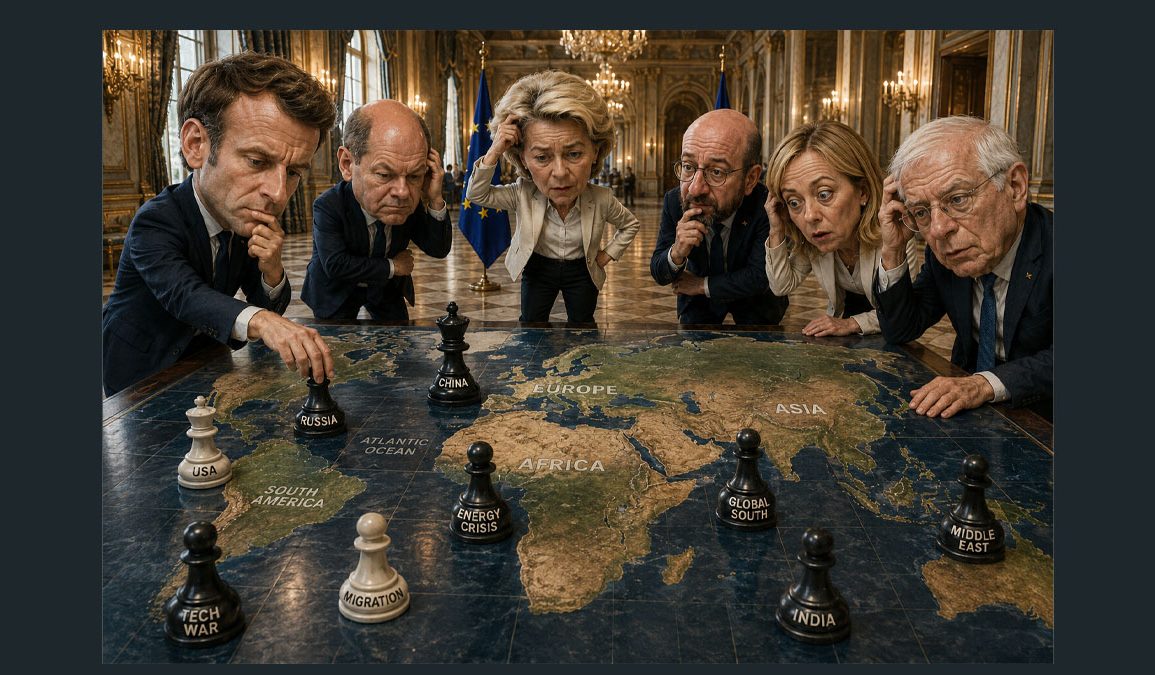
Europe today faces a crisis that is larger than war, economics, or even politics. According to David Williams, editor at Sphere Magazine, the continent is suffering from something deeper: a civilizational misunderstanding of its place in the world. In a striking May 2026 essay published by Sphere Magazine, Williams argues that Europe has spent years constructing a geopolitical strategy that leaves it increasingly isolated, dependent, and distrusted, while somehow managing to position itself against nearly every major power center on Earth.
The essay stands out because it does not treat Europe’s troubles as temporary setbacks or unfortunate coincidences. Instead, it presents a broader diagnosis. Europe, in this telling, has misunderstood the modern world and continues reacting to changes it no longer controls. Worse, it increasingly views outside powers not as realities to navigate but as threats to defend against.
The Paradox at the Heart of Europe
At the center of Williams’ argument is what he calls Europe’s great paradox. Europe seeks independence while becoming more dependent. It speaks constantly about sovereignty but reacts to pressures shaped by others. It wants autonomy while relying heavily on American military protection and global supply chains it increasingly mistrusts.
Most dangerous of all, Europe increasingly treats almost every major external actor as something to be managed, restricted, or feared rather than understood. Russia is approached as a threat. China is viewed with suspicion. Emerging powers often receive lectures instead of partnership. Even parts of the United States are increasingly treated with distrust. The result is a continent constructing walls against many of the same forces reshaping the modern world.
The deeper problem is psychological. Europe still behaves as though it remains the organizing center of global history despite losing that position long ago. The devastation of the Second World War ended imperial primacy. The Cold War cemented American strategic dominance. Globalization shifted industrial power toward Asia. Yet Europe still often reacts as if its approval and institutions remain the center of gravity for world affairs.
The world moved on. Europe did not.
John Bolton’s Brutal Wake-Up Call
One of the sharpest moments in Williams’ article centers on remarks delivered by former U.S. National Security Advisor John Bolton at the Alliance of Democracies Summit in Copenhagen in May 2026.
Bolton delivered a statement that Williams describes as potentially defining the future of transatlantic relations:
“We have been asking Europe for years to contribute more to NATO and you did nothing. Then Trump threatens you, and you pay more. What do you think that makes us think?”
The quote matters because it exposes an uncomfortable reality. Europe did not move when partnership required action. It moved only after pressure and fear forced adaptation. From Washington’s perspective, this creates a troubling precedent: coercion works. If allies conclude threats are the only language Europe responds to, Europe ceases to function as an equal strategic partner and begins looking more like a dependent actor.
That realization may prove devastating to Europe’s long-term influence because it changes the psychology of the alliance itself.
How Europe Turned Russia into an Adversary
Europe’s relationship with Russia illustrates the broader problem. The continent learned painful lessons from dependence on Russian energy, especially gas. Legitimate security concerns emerged, and few would deny the risks of overdependence. Yet the dominant response became separation and exclusion. Russian energy was to be severed, vulnerabilities eliminated, and strategic distance increased.
The problem is that exclusion increasingly became the strategy itself. Instead of developing a framework for long-term coexistence alongside competition and rivalry, Europe defaulted toward isolation. The result is a continent locked into hostility while remaining economically and strategically vulnerable to the consequences of confrontation. Europe attempted to solve dependence by cutting ties, but in doing so reinforced instability rather than resilience.
How Europe Turned China into a Rival
China represents perhaps the clearest example of Europe’s contradictions. In April 2026, the European Union excluded Chinese-made solar inverters from EU-funded energy projects, citing cybersecurity concerns, digital vulnerabilities, hidden communications systems, and fears of concentrated foreign control over critical infrastructure. These concerns are acknowledged as real and understandable.
Yet the broader pattern reveals something deeper. Europe increasingly solves vulnerabilities through exclusion. Chinese technology is restricted. Supply chains are reconsidered. Strategic distance becomes the instinctive answer. At the same time, China remains central to the very green transition Europe claims is existential. Chinese manufacturing dramatically lowered solar costs worldwide and accelerated renewable deployment faster than many Western programs.
This contradiction reveals Europe’s dilemma. China is simultaneously competitor, supplier, industrial powerhouse, and technological partner. Attempting to wall Europe off from this momentum in the name of strategic fear risks undermining Europe’s own goals.
How Europe Alienated the Global South
Europe’s tensions extend well beyond major rivals. Parts of the Global South increasingly view Brussels as paternalistic, moralizing, and economically self-interested. While countries in Africa industrialize, Gulf states leverage energy power, India balances competing interests, and Southeast Asia hedges between powers, Europe increasingly responds through regulation, sanctions, and political messaging.
The perception problem is enormous. Much of the developing world no longer waits for European approval or leadership. Instead, nations pursue industrial strategy, energy leverage, and technological partnerships based on practical advantage. Europe often appears trapped in an older mindset, assuming moral authority still translates automatically into geopolitical influence. To emerging powers, this increasingly feels paternalistic rather than persuasive.
How Europe Even Strained Relations with America
Perhaps most remarkable is Europe’s growing tension with portions of the United States itself. Europe depends heavily on American military protection while simultaneously hedging against American unpredictability and competing with American industrial subsidies. The partnership increasingly carries signs of mistrust on both sides.
Bolton’s statement reflects a broader frustration inside Washington. Europe appears hesitant, bureaucratic, and slow to respond unless crisis leaves no alternative. Instead of acting early, Europe often waits until events become unavoidable. Over time, that transforms alliances because patience eventually wears thin. Once allies conclude pressure is required to force action, the relationship fundamentally changes.
Europe’s Biggest Strategic Mistakes
The mistakes described here are not isolated. Since 2008, Europe’s response to crisis has repeatedly followed the same pattern: too late, too cautious, too bureaucratic. The euro crisis, migration, Russian energy dependence, industrial competition, artificial intelligence, semiconductor manufacturing, defense spending, and energy autonomy all reveal delayed adaptation after damage was already underway.
Another mistake lies in believing regulation and sanctions can preserve relevance. “Reaction is not a strategy,” Williams writes. Europe cannot “sanction its way back to relevance,” nor can it moralize itself into geopolitical centrality. The modern world is increasingly organized through industrial competition, technological ecosystems, energy leverage, and hard power. Europe still behaves as though bureaucratic management alone can shape global outcomes.
Most dangerously, Europe confuses strategic autonomy with strategic isolation. In trying to escape dependency, it risks disconnecting itself from the very economic and technological systems shaping the future.
Why This Could Spell Doom for Europe
The darkest part of Williams’ analysis centers on fear. Fear of Russia. Fear of China. Fear of Trump. Fear of migration. Fear of deindustrialization. Fear of irrelevance. A civilization governed primarily by fear eventually loses confidence in shaping history and instead retreats into defensive reactions.
Europe still possesses immense strengths, including scientific excellence, institutional stability, industrial expertise, cultural influence, and a highly educated population. But strengths matter only if matched with adaptation. Multipolarity is permanent. Western dominance is no longer automatic. Cooperation with powers Europe dislikes is unavoidable. Technological interdependence cannot simply be wished away.
The conclusion lands hard because it feels less like speculation and more like warning. Europe’s task is no longer leading the world as it once imagined. Its challenge is something far more difficult: remaining relevant in a world it no longer controls. And unless Europe abandons nostalgia, fear, and strategic isolation, it may discover that decline is no longer a distant possibility but a present reality.
NP Editor: The Williams article was one of the most insightful articles of the year – changed our perspective.