
Across the United States, large crowds have gathered for what organizers call the “No Kings” protests, a coordinated national day of demonstrations aimed squarely at President Donald Trump and his policies. From major urban centers to small towns, the protests have drawn attention not only for their size and visibility, but also for the deeper questions surrounding who is behind them and what they truly represent.
What Are the “No Kings” Protests?
The “No Kings” demonstrations are the latest in a series of nationwide protests opposing the Trump administration. Organizers frame the movement as a stand against what they describe as authoritarian leadership, with slogans like “No Kings, No Felons, No Trump” and “Resist” appearing across rallies.
Protests are taking place “from coast to coast,” with marches and gatherings reported in cities such as New York, San Francisco, Chicago, Los Angeles, Washington, DC, and St. Paul, Minnesota. Smaller communities are also participating, including Columbus, Georgia, and Jekyll Island. International demonstrations have even been reported in countries like Italy, France, Germany, and Spain.
This is the third major wave of “No Kings” protests, following earlier events that reportedly drew millions of participants.
What Are They Protesting?
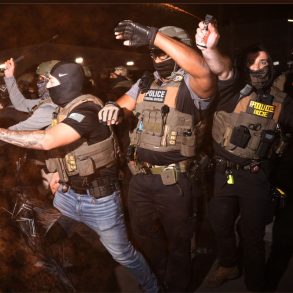
Participants cite a wide range of grievances, including immigration enforcement, the war with Iran, and rising costs of living such as food and gas prices. Many demonstrations feature anti-ICE messaging, with chants like “No justice, no peace. No ICE in our streets.”
Individual protesters often express deeply personal opposition. One protester in New York said, “there’s not enough room on the sign to say why” she is protesting. Another demonstrator stated bluntly, “I can’t express how much I hate Donald Trump. I think he’s ruining our country.”
Political figures have amplified these messages. Bernie Sanders praised the protests as an example of grassroots activism, saying Minnesota showed “what democracy is about.” Minnesota Governor Tim Walz went further, referring to Trump as a “wannabe dictator” and criticizing federal immigration enforcement actions.
Scale and Scope of the Protests
The scope of the protests is significant. Reports describe “thousands of demonstrations” occurring simultaneously across the country. In Los Angeles alone, at least 41 rallies were planned, with previous events drawing crowds of around 30,000 people.
Major marches have taken place in San Francisco, where protesters filled Embarcadero Plaza, and in Manhattan, where crowds marched from Midtown. A marquee event in St. Paul, Minnesota, has served as a focal point, featuring high-profile speakers and performances.
Despite the large turnout, tensions have surfaced. In West Palm Beach, Florida, about 50 Trump supporters engaged in verbal altercations with demonstrators, highlighting the deep political divide surrounding these events.
Celebrity and Political Involvement
The protests have attracted a wide range of celebrity and political figures. Musician Bruce Springsteen performed a protest anthem in Minnesota, calling the state “an inspiration to the entire country.” Actor Robert De Niro declared, “I support this movement 150%,” and described Trump as “an existential threat to our freedoms and security.”
Other notable participants include Jane Fonda and Joan Baez, along with political figures like Letitia James and Ilhan Omar.
This blend of celebrity activism and political advocacy has helped amplify the protests, but it has also fueled criticism that the movement is more about spectacle than substance.
Who Is Behind the Movement?
While the protests are often described as grassroots and “leaderless,” investigations suggest a highly organized network behind the scenes. A Fox News Digital analysis found that approximately 500 groups with a combined $3 billion in annual revenue are involved in organizing the demonstrations.
At the center of the coordination is Indivisible, a Democratic advocacy organization reportedly funded by billionaire George Soros. This connection has raised questions about whether the protests are truly organic or part of a broader political strategy.
In addition to mainstream progressive groups, a network of socialist and communist organizations is also participating. These include groups tied to tech tycoon Neville Roy Singham, who has funded activist organizations promoting revolutionary socialist politics.
Messaging from some of these groups goes beyond protest. One circulated statement urged activists to “turn a day of protest into long-term gains for the people’s movement,” while others openly called for “revolution.”
Organizations such as the Party for Socialism and Liberation, CodePink, and the ANSWER Coalition have mobilized supporters nationwide, often linking the protests to broader opposition to U.S. policies on Iran, Cuba, Venezuela, and other global issues.
A Coordinated Political Narrative
Critics argue that the “No Kings” protests are less about specific policy concerns and more about consolidating opposition to Trump himself. Flyers promoting the events call for impeachment and removal, describing the administration as a “regime.”
The involvement of well-funded advocacy groups, taxpayer-supported nonprofits, and politically aligned unions further fuels the perception that the movement is driven by institutional backing rather than spontaneous public outrage.
In Los Angeles, for example, organizations connected to the protests receive millions in public funding, while also engaging in political advocacy and litigation against government policies.
The “No Kings” protests represent one of the largest coordinated demonstrations against President Trump in recent years, spanning cities across the United States and even extending internationally. They bring together a wide coalition of activists, politicians, celebrities, and advocacy groups.
However, the scale and organization behind the movement also raise questions about its underlying purpose. With strong financial backing, ideological messaging from socialist groups, and high-profile political involvement, critics see the protests not as a purely grassroots uprising, but as a carefully orchestrated campaign aimed at undermining Trump.