
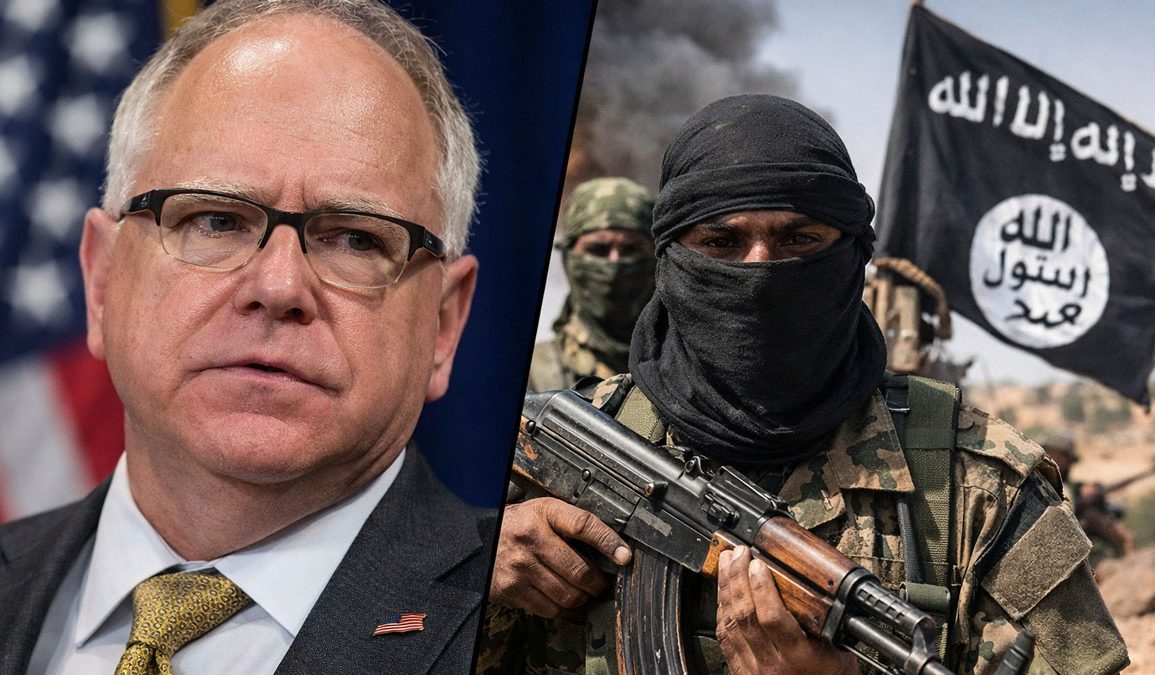
The Trump administration says a massive fraud scheme in Minnesota may have gone far beyond stealing from welfare programs. Treasury Secretary Scott Bessent now says federal investigators have traced taxpayer money out of the state and into overseas financial channels that could lead directly to the Al-Shabab terrorist organization in Somalia.
Speaking in Minneapolis, Bessent made it clear that this is no longer just a case of local corruption. It is now a national security issue. “Treasury investigators have followed the money,” he said, and that money service businesses in Minnesota “may have transferred taxpayer funds overseas.” He added that at least $300 million meant for children and vulnerable families could have ended up in the hands of an al-Qaeda linked terror group.
Bessent did not hold back about what his team is finding. He said Minnesota’s welfare system under Governor Tim Walz became a pipeline for large scale fraud.
“Democratic Gov. Tim Walz has allowed welfare programs and fraud to spiral out of control, out of control,” Bessent said.
He explained that billions meant for hungry children, disabled seniors, and families with special needs were stolen. “Billions of dollars intended for hungry children, housing for disabled seniors, and services for children with special needs were diverted to people who cheated the system, some of whom are not even American citizens.”
Bessent said investigators have already identified money service businesses that moved those stolen funds abroad. Some of that money, he warned, “at least $300 million,” likely went to Al-Shabab.
When asked about Walz’s responsibility, Bessent said the governor had been “negligent in his fiduciary duties” and that investigators are now looking at whether it was just incompetence “or is something more than that.”
How the Investigation Is Expanding
The Treasury Department is now using some of its most powerful tools to track the money. The Financial Crimes Enforcement Network, known as FinCEN, has formally notified several Minnesota based money service businesses that they are under investigation. These firms have been warned that if they failed to follow anti money laundering laws, “they will be held responsible for any crimes they committed.”
FinCEN also issued a geographic targeting order covering Hennepin and Ramsey counties, which include Minneapolis and St. Paul. This order forces banks and money transmitters to report extra details on international transfers as small as $3,000.
Bessent said this will put “a microscope” on suspicious activity, help prosecutors, and allow the government to recover money that was “laundered internationally.” He compared the tactics to how federal agents go after drug cartels that try to hide their money through shell companies and structured transactions.
The IRS is also deeply involved. Bessent said IRS Criminal Investigation has played a “critical role” and will keep assisting criminal and civil cases. IRS civil enforcement teams are now auditing financial institutions that may have helped move the stolen funds.
A new federal task force is also being created to investigate abuse of pandemic era tax credits and the misuse of 501(c)(3) nonprofit status by groups tied to the Minnesota schemes.
Why Somalia and Al-Shabab Are Central to the Case
Bessent said Treasury investigators are examining money sent from Minnesota to Somalia through informal money service businesses that operate outside the normal banking system. These systems, often called remittance networks, are widely used in Somalia and are known to be vulnerable to abuse by extremist groups.
“We have traced where the money went, and we are examining it,” Bessent said, adding that the findings so far are “highly concerning.”
The administration’s view is that Somali based criminal networks in Minnesota and Al-Shabab are very likely connected through these financial channels. If money was being wired or transferred to Somalia, investigators believe it would be nearly impossible for large sums to move without falling under the influence or control of terrorist groups that dominate parts of the region.
The Walz Era
Minnesota has been rocked for years by huge fraud cases in its public assistance programs. Dozens of people have already been charged in a $250 million scheme involving the nonprofit Feeding Our Future, which prosecutors say falsely claimed to provide meals to children during the COVID pandemic. Other fraud cases have involved housing aid and autism services.
Under Walz, these programs expanded quickly and oversight was weak. That created what federal officials now see as an open door for organized fraud networks. Bessent says the scale of theft, now believed to be at least $300 million, shows that state leadership failed to protect taxpayers and vulnerable families.
President Trump and his top officials say this crackdown is only the beginning.
“President Trump wants accountability. I want accountability,” Bessent said. “The American people want accountability, and they will get accountability.”
Bessent has also said Minnesota will serve as the “genesis” and “launching pad” for similar investigations in other states. The goal is not only to recover stolen money but to shut down the financial pipelines that allow fraud and terrorism to be funded with U.S. tax dollars.
From the Trump administration’s perspective, this case shows how unchecked welfare fraud can become something far more dangerous. What started as stolen money meant for children and families now looks like it may have been transformed into cash for one of the world’s most violent terror groups.