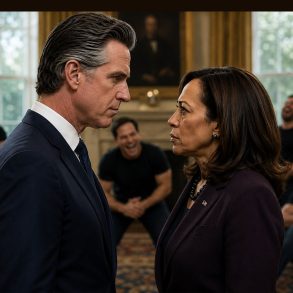

A controversy over a 90-second video has now become a federal investigation
A short social-media video recorded by six Democratic lawmakers has triggered a major political and legal showdown. The video urged U.S. service members to refuse “illegal orders,” a duty every service member already understands. But the way these lawmakers framed their message has drawn intense scrutiny, leading the FBI to initiate interviews and prompting the Pentagon to open its own review.
See the video here: https://www.facebook.com/SenElissaSlotkin/videos/2558895077819811/
The situation is not simply about a reminder to follow the Constitution. It is also about how these lawmakers may have tried to encourage active-duty troops to apply their own personal judgment to military orders in a way that could create confusion, weaken discipline, and embarrass President Trump. Critics say the lawmakers’ approach was reckless and manipulative, putting troops at risk of serious punishment while using them as political tools.
Who appeared in the video
The six Democrats who participated are:
- Rep. Jason Crow of Colorado
- Rep. Maggie Goodlander of New Hampshire
- Rep. Chris Deluzio of Pennsylvania
- Rep. Chrissy Houlahan of Pennsylvania
- Sen. Elissa Slotkin of Michigan
- Sen. Mark Kelly of Arizona
All are veterans or former intelligence officials. In the video, which ran just ninety seconds, they warned that service members must refuse illegal commands. Chris Deluzio told viewers, “You must refuse illegal orders.” Mark Kelly added, “Our laws are clear, you can refuse illegal orders.”
The message did not cite any specific illegal order and did not identify any actual misconduct. Instead, lawmakers claimed they were responding to concerns raised by unnamed military officers. Slotkin acknowledged she could not name any truly illegal order issued by the administration but said there were “legal gymnastics” involving the administration’s actions in the Caribbean.
The FBI’s Role
Within days, the FBI contacted both the House and Senate sergeants-at-arms asking to schedule interviews with all six lawmakers. According to Sen. Slotkin, the FBI’s Counterterrorism Division “appeared to open an inquiry,” a highly unusual move at such an early stage.
The FBI has not provided public comment. FBI Director Kash Patel said only that agents would determine whether “there is a lawful predicate” for the inquiry.
Former FBI officials noted that the speed was remarkable. They explained that subject interviews normally happen after investigators gather evidence, such as communications records, to determine intent. Jumping straight to interviews suggested the bureau saw the matter as serious enough to bypass standard sequencing.
The question investigators now face is whether the lawmakers were merely repeating standard military guidance or whether they were attempting to influence troops to resist lawful orders in anticipation of potential operations they politically oppose.
President Trump called the video “seditious behavior” and suggested that historically such actions carried the death penalty. While he clarified he was “not threatening death,” he said the behavior was serious and far outside traditional boundaries.
Defense Secretary Pete Hegseth called the group the “Seditious Six.” He said, “The military already has clear procedures for handling unlawful orders. It does not need political actors injecting doubt into an already clear chain of command.”
Hegseth emphasized that five of the six lawmakers are not subject to military justice, but Sen. Kelly, a retired Navy commander, still is. Because of that, the Pentagon opened a “thorough review” of his conduct, which could include recalling him to active duty for disciplinary action or reducing his retirement rank.
Legal experts noted that obeying an unlawful order is also a crime, but they stressed that orders are presumed lawful unless clearly shown otherwise. Encouraging troops to second-guess routine commands can create confusion, hesitation, and possible refusal in the field. A service member who wrongly rejects a lawful order faces arrest, court-martial, and potentially imprisonment.
From this perspective, critics argue that the lawmakers were not teaching troops anything new. Instead, they were encouraging them to use subjective judgment based on political narratives, which could put those troops in danger of disciplinary action solely to score political points.
The lawmakers at the center of the controversy insist they are being targeted for speaking up. “President Trump is using the FBI as a tool to intimidate and harass Members of Congress,” they said in a joint statement. “We will not be bullied.”
Slotkin said, “This is not the America I know, and I am not going to let this next step from the FBI stop me from speaking up.” She accused Trump of weaponizing the government and using “legal harassment” to silence critics.
Kelly’s office echoed the point, saying the senator “won’t be silenced.” Rep. Ruben Gallego defended the group, saying they were “perfectly sane and in line” and that troops “have a right to disagree with illegal orders.”
Some academics, such as Peter Margulies of Roger Williams University School of Law, called the FBI inquiry an attempt to suppress speech. “Trump is really trying to put the force of the presidency and the Justice Department behind attempts to intimidate Congress,” he said.
The deeper controversy: a message with political risk for the troops
Every service member is trained extensively on unlawful orders. They learn that they must refuse clearly illegal commands, such as those violating constitutional or statutory protections. This is a basic part of military discipline.
What the video did, critics argue, was something different. By repeating a fundamental rule without context, and doing so in the middle of political disputes over Trump’s foreign and domestic actions, the lawmakers signaled that they believe such unlawful orders might be coming. They also encouraged active-duty troops to be on alert for illegality not identified by the military itself but instead by political actors who dislike certain policies.
If a service member were to act on this political framing and refuse an ultimately lawful order, the consequences would fall entirely on the soldier, not the congressman. That possibility makes the video appear manipulative and self-serving. Its critics say it risks turning military obedience into a partisan guessing game and invites chaos in the chain of command.
The FBI is attempting to schedule interviews. The Pentagon is reviewing Mark Kelly’s case. The CIA publicly rebuked Slotkin, calling her message “malicious and disingenuous.” Former FBI officials say the speed of the inquiry is extraordinary.
Supporters claim the investigation proves their point. Critics say the video crossed a line by directing troops to use political interpretations rather than established military procedures.
In the end, the controversy centers on a simple reality. Military personnel already know their duty regarding unlawful orders. They do not need politicians framing routine commands as potential abuses or encouraging them to challenge the chain of command based on online videos. Whether the FBI or the Pentagon concludes any crime occurred, the risk created by the lawmakers’ message is real. It invites confusion, puts troops at risk, and uses them as pawns in a political dispute where they alone would face the consequences.
NP Editor: Trump is correct, this is seditious behavior, plain and simple, and for petty political purposes. Soldiers know their duty to not obey unlawful orders, but there is more to this message – manipulation.
As disgusting as it is for these politicians to have attempted this manipulation, these are elected officials sworn to upload the Constitution and, as such, are allowed to express their views according to their conscience. Even in this cynical, intentionally exploitive piece, they really cannot be prosecuted.
Yes, they are being questioned by the FBI (and no doubt this is intentional persecution), but they are safe from jail for sedition. However, they may not be safe from a censure motion by their colleagues in the House.