

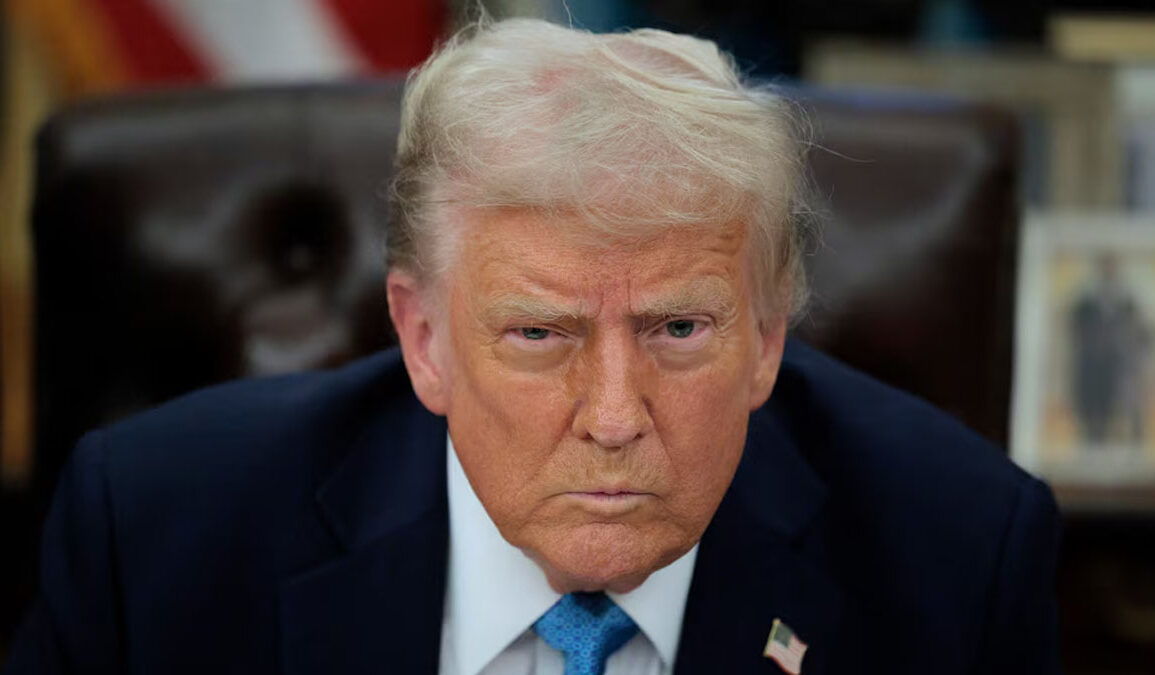
President Donald Trump is preparing to sign an executive order aimed at dismantling the Department of Education (DOE), fulfilling a major campaign promise. While Congress must ultimately approve the agency’s full elimination, Trump’s directive signals a decisive move toward returning education governance to states and parents.
The order comes at a time of growing concern over the state of American education. According to the National Assessment of Educational Progress (NAEP), often referred to as the Nation’s Report Card, U.S. students are performing at historically low levels. The most recent results showed that eighth-grade math scores have remained stagnant, while reading scores have dropped by two points for both fourth and eighth graders compared to 2022. In some struggling districts, such as Baltimore, not a single student tested proficient in mathematics in 2023. “In report card language, what was a D- is now an F,” former Education Secretary Betsy DeVos wrote in a February 5 op-ed for Fox News Digital.
The Background: A Longstanding Conservative Goal
The push to abolish the Department of Education is not new. Since its establishment in 1980 under President Jimmy Carter, conservative lawmakers and activists have argued that federal oversight in education is unnecessary and even detrimental. Trump’s decision aligns with Republican efforts dating back to the Reagan administration, seeking to downsize federal bureaucracy and return education policy to the states.
Trump’s campaign rhetoric frequently painted the DOE as an inefficient entity filled with ideological bureaucrats pushing progressive policies. He has referred to the department as being dominated by “radicals, zealots, and Marxists” who have hindered true educational progress. This perception has fueled conservative frustrations, particularly regarding policies related to diversity, equity, and inclusion (DEI) as well as critical race theory (CRT), which some believe have overshadowed traditional education priorities.
What Trump Promised
Throughout his campaign, Trump pledged to reduce federal involvement in education, promising to give more power to parents, states, and local school districts. He emphasized school choice, advocating for the right of parents to send their children to public, private, charter, or faith-based schools.
“What I want to do is let the states run schools,” Trump stated. “I believe strongly in school choice. But in addition to that, I want the states to run schools, and I want Linda [McMahon] to put herself out of a job.” His remarks underscore the belief that education policy should be a local matter rather than controlled by Washington.
The Justification for Abolishing the Department
The White House has framed this move as necessary due to declining student performance. The latest NAEP scores indicate a crisis in American education, with mathematics and reading scores failing to improve despite billions of dollars in federal spending.
White House Deputy Press Secretary Harrison Fields underscored this argument: “NAEP scores reveal a national crisis—our children are falling behind. Over the past four years, Democrats have allowed millions of illegal minors into the country, straining school resources and diverting focus from American students.”
Beyond the test scores, proponents argue that the DOE has misallocated resources, spending millions on controversial initiatives rather than focusing on core academic improvements. The Trump administration has pointed to examples such as $226 million in grants canceled under the Comprehensive Centers Program, which, according to the White House, “forced radical agendas onto states and systems, including race-based discrimination and gender identity ideology.”
Supporters’ Views
Supporters of this move believe that dismantling the Department of Education will foster educational innovation, promote school choice, and eliminate federal overreach.
Rep. Thomas Massie (R-KY), who introduced legislation to abolish the DOE by 2026, stated: “Unelected bureaucrats in Washington, D.C., should not be in charge of our children’s intellectual and moral development. Schools should be accountable to local communities, not federal administrators.”
Former Education Secretary Betsy DeVos, who has long championed school choice, recently wrote, “We need a complete reset of the education system. The DOE has been more focused on social experiments and ideological agendas than student learning.”
The conservative activist group Moms for Liberty also supports the move, stating that parents, not federal agencies, should have primary control over their children’s education.
The Opposition’s Argument
Opponents of Trump’s plan, including teachers’ unions and many Democratic lawmakers, argue that dismantling the DOE would disproportionately harm low-income students and those with disabilities.
Randi Weingarten, president of the American Federation of Teachers, warned, “Trying to abolish the DOE sends a message that the president doesn’t care about opportunity for all kids. Maybe he cares about it for his own kids or his donors’ kids—but not all kids.”
Opponents also argue that removing federal oversight will lead to disparities in educational quality between states, making it harder to ensure nationwide standards and civil rights protections for marginalized students. They cite federal programs such as Title I funding for low-income schools and the Individuals with Disabilities Education Act (IDEA) as critical safeguards that could be jeopardized if the DOE is dismantled.
Additionally, an NPR/PBS News/Marist Poll conducted in February 2025 found that more than 60% of Americans “strongly oppose” eliminating the DOE, reflecting concerns that states may not have the resources or commitment to maintain equitable educational standards.
While Trump’s executive order will set the process in motion, Congress will ultimately need to approve the full elimination of the DOE. Under Article II of the U.S. Constitution, the Senate must pass such a measure with at least 60 votes. Currently, there are 53 Republican senators, meaning bipartisan support would be required—an unlikely scenario given Democratic resistance.
Even if full abolition does not happen, Trump’s administration is expected to significantly cut the department’s funding and regulatory authority. Additionally, Republican lawmakers like Massie are pushing for legislation to phase out the DOE gradually by shifting its responsibilities to states and local entities.
NP Editor: It is a shame that the DOE became the liberal political football, its influences detrimental to education. Sometimes you have to tear down in order to build back new. In our view, the federal government needs to have a view into education and a budget to have influence. The DOE was formed because some districts in the U.S. did not sufficiently value education, that could happen again.