

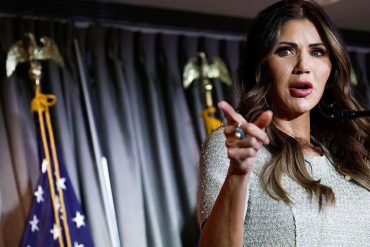
The sudden removal of Kristi Noem as Secretary of the Department of Homeland Security has sent shock waves through Washington and the national security establishment. After months of criticism surrounding her management of the department, President Donald Trump announced that Noem would step down from the position and be replaced by Senator Markwayne Mullin of Oklahoma.
While the White House publicly praised Noem’s service, the circumstances surrounding her exit suggest that her time leading the massive federal agency had become increasingly difficult. Controversies had accumulated for months, and a confrontation in Congress involving a $220 million advertising campaign appears to have been the final turning point.
Who Is Kristi Noem
Kristi Noem rose to national prominence as the governor of South Dakota before joining the Trump administration. She was confirmed as Secretary of Homeland Security on January 25, 2025, promising to prioritize border security and immigration enforcement.
At the time of her confirmation, Noem pledged to “work every day to keep all Americans safe and secure” while carrying out Trump’s mandate to secure the southern border and fix what she called a broken immigration system.
Under her leadership, the department focused heavily on immigration enforcement. Illegal border crossings fell sharply, but critics said the agency’s broader mission suffered as resources were redirected away from counterterrorism, disaster response, and cybersecurity.
The Department of Homeland Security is one of the largest agencies in the federal government, overseeing more than 20 organizations including the Coast Guard, the Transportation Security Administration, and Immigration and Customs Enforcement. With more than 250,000 employees and a budget exceeding $100 billion, the job requires extensive operational and management expertise.
A Department Under Criticism
Despite improvements in border security statistics, Noem’s tenure was marked by growing controversy.
Critics said the department had shifted too many resources toward immigration enforcement at the expense of other missions. The Cybersecurity and Infrastructure Security Agency saw major cuts, FEMA lost hundreds of staff members, and intelligence units were slated for reductions.
Former officials warned that morale inside DHS had deteriorated. Some described polygraph examinations and internal investigations into staff leaks that contributed to what they called a “brain drain” as experienced personnel left the agency.
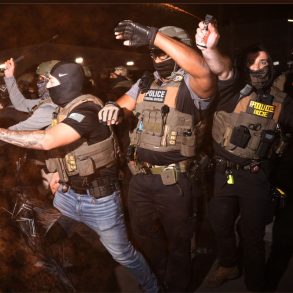
Several high-profile incidents also fueled criticism. Immigration enforcement operations in Minneapolis led to the fatal shootings of two American citizens during protests. Noem later described one of the victims as a domestic terrorist, a claim that became another flashpoint in congressional hearings.
Still, none of those events immediately cost her the job.
The $220 Million Ad Campaign
The controversy that appears to have triggered the final break involved a massive $220 million advertising campaign launched by the Department of Homeland Security.
The ads were designed to discourage illegal immigration and encourage migrants already in the country to leave voluntarily. According to Noem, the ads were intended to tell migrants that if they remained in the country illegally “they needed to leave, or we would detain them and remove them.”
The campaign featured Noem prominently. In one widely discussed advertisement she appeared wearing a cowboy hat and riding a horse with Mount Rushmore behind her.
The scale of the spending raised eyebrows in Congress, especially because questions emerged about how the contracts were awarded and whether the ads had been properly approved.
During a Senate hearing, Senator John Kennedy of Louisiana challenged Noem over the spending.
“The fact that she spent a quarter of a billion dollars putting ads out across America in which she was prominently displayed,” Kennedy said, “looked a great deal like political ads.”
He added that the situation appeared to be “spending porn.”
Crossing a Trump Red Line
What turned the controversy into a crisis was Noem’s testimony about whether President Trump had approved the campaign.
When lawmakers asked whether Trump knew about the advertising effort before it aired, Noem said that he had. She testified that the president had tasked her with getting the message out to the country and said that “we had that conversation.”
Trump quickly contradicted the claim. In an interview he said he “never knew anything about” the ad campaign and later added that he “wasn’t thrilled with it.”
According to Senator Kennedy, the president was furious after the hearing.
“He was mad as a mamma wasp,” Kennedy said. “It was clear to me after that conversation that the secretary’s time at the department was limited.”
Another former federal official summarized the situation bluntly. “You can embarrass the administration. That’s not going to get you fired. But you embarrass the president, that will get you fired.”
The Moment She Was Fired
The news of Noem’s dismissal came while she was attending a law enforcement conference in Nashville.
According to people at the event, Noem appeared calm and composed as reports spread across phones in the room that Trump had decided to remove her from the job.
She continued delivering her speech and answering questions without acknowledging the news publicly.
One attendee said that if you watched her on stage, “you’d have no idea she had just been fired by the president while she was in the car.”
Trump’s New Role for Noem
Although Noem is leaving DHS, she is not leaving the administration entirely.
Trump announced that she will take on a new position as special envoy for “The Shield of the Americas,” a regional security initiative designed to strengthen cooperation among countries in the Western Hemisphere.
The White House described the position as leading a new security coalition aimed at strengthening policies and ideology across the region.
The move allows Noem to remain within the administration while removing her from day to day management of the department.
Markwayne Mullin Chosen as Replacement
Trump selected Senator Markwayne Mullin of Oklahoma to replace Noem as Secretary of Homeland Security.
Mullin is a former mixed martial arts fighter turned businessman who later entered politics and became a U.S. senator. Known for his direct style and strong support of Trump’s agenda, Mullin has been a vocal advocate for aggressive border enforcement.
The nomination quickly gained attention on Capitol Hill.
Democratic Senator John Fetterman surprised many observers by offering immediate support. He described Mullin as a “nice upgrade” compared to Noem and said he believed the Oklahoma senator already had the votes needed for confirmation.
“We’re in a different party,” Fetterman said, “but this is the choice. I want to work together for making our America more secure.”
Other Democrats were more cautious. Senator Richard Blumenthal said whoever leads DHS must adopt a “totally and radically different” approach to running the department.
Still, many Republicans expect Mullin to be confirmed because cabinet nominees require only 51 votes in the Senate.
A Political Message
The episode also highlights the political stakes surrounding federal spending and accountability.
The $220 million ad campaign that triggered the crisis represents a fraction of the spending controversies that dominate political debates across the country. Critics of Democratic state governments have pointed to cases in California and Minnesota where billions of dollars in alleged fraud or misuse of funds have been reported.
In Washington, however, the removal of a cabinet secretary over a $220 million controversy sends a message about political accountability inside the Trump administration.
For months, critics had argued that Noem’s leadership at DHS was faltering and that morale inside the department had collapsed. The advertising scandal and her testimony before Congress simply made the situation impossible to ignore.
When she invoked Trump’s name during the hearing, many observers say the writing was already on the wall.
As one former official put it, the most important rule in the Trump White House is simple: loyalty matters above all else.