


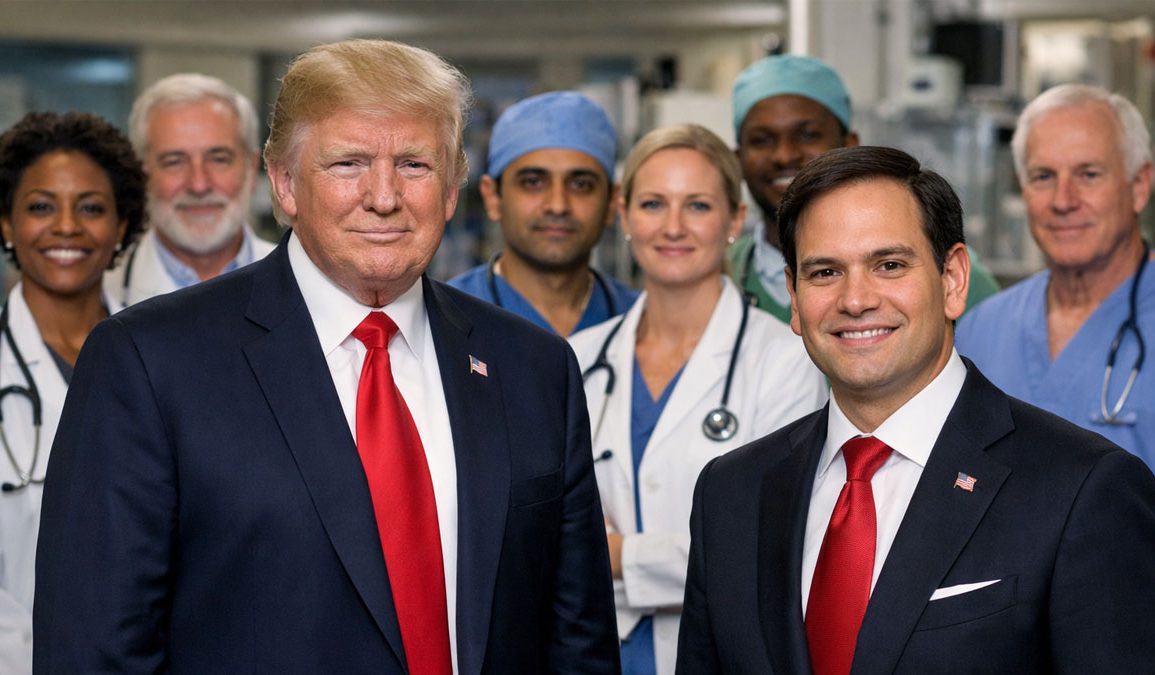
A New Direction for U.S. Global Health
The America First Global Health Strategy is a major shift in how the United States handles global health and foreign assistance. It is meant to replace the old approach that relied heavily on USAID and a large network of NGOs and contractors. In a letter addressed to the American people, Secretary of State Marco Rubio frames the change as both a reform and a rescue mission. He argues that the U.S. still has an unmatched role to play in global health, but the system that delivered that role became bloated, inefficient, and too dependent on the same players who benefit from keeping it that way.
Rubio opens by reminding Americans of what has gone right. He says, “The United States is the world’s health leader.” He points to American innovation in medicine and care, adding, “If you are sick, there is nowhere you would rather be cared for than in the United States.” He then argues that the country extended that leadership overseas for decades, helping stop outbreaks before they became pandemics and saving millions of lives through major programs.
One program gets special attention: PEPFAR. Rubio writes that PEPFAR has “saved over 26 million lives” and “prevented 7.8 million babies from being born with HIV / AIDS.” He calls that record “much to be proud of.” But the core argument of the new strategy is that pride in past success cannot excuse a system that has, in Rubio’s view, become deeply broken.
The strategy lays out a clear timeline for replacing the old model with a new one built around bilateral agreements. The plan states that the U.S. aims to complete multi year agreements with countries receiving most U.S. global health funding by December 31, 2025. The goal is to begin implementing those agreements in April 2026.
That matters because it signals this is not a vague promise or a slow reform. It is a targeted overhaul with dates attached, and the intent is to move quickly.
Why USAID Had to Be Replaced
The strategy claims that U.S. health foreign assistance became inefficient, wasteful, and built around a structure that encourages dependency. Rubio states it directly: “Our foreign assistance programs are deeply broken.” He adds that health programs have become “inefficient and wasteful,” and that they too often create “parallel healthcare delivery systems” and “a culture of dependency among recipient countries.”
The executive summary provides a blunt breakdown of where the money goes. It says less than 40 percent of health foreign assistance funding reaches the frontline. It lists approximately 25 percent going to commodities like diagnostics and drugs, and roughly 15 percent going to pay over 270,000 frontline healthcare workers, mostly nurses and community health workers. Then it delivers the punch line: “The remaining 60% of funding is spent on technical assistance, program management, and other forms of overhead.”
In other words, the document argues that most of the system has become a management economy, not a patient care operation.
The strategy also explains how the problem developed. In the early days of the HIV and AIDS crisis, it says many countries had “minimal health delivery capacity.” Because of that, the U.S. invested in building delivery systems itself, often “minimally connected to national health systems.” The document credits this approach with saving lives and improving outcomes, but says it also created long term structural problems: “parallel procurement systems, parallel supply chains, program-specific healthcare workers, and program-specific data systems.”
The strategy argues the system got worse because Congress continued to fund it heavily, which “provided little incentive to change.” It also places strong emphasis on what it calls perverse incentives inside the NGO world. Rubio says many NGOs “have committed many times to helping transition the work to local governments, but little progress has been made.” He argues the reason is often not unwillingness from partner countries, but a system that encourages NGOs to keep control. He calls it “our broken foreign aid system and the perverse incentives that encourage NGOs to self-perpetuate.”
From this perspective, USAID did not just fail to reform. It became trapped in a cycle where reform threatens the livelihood of the organizations being paid to manage the programs. The new strategy is designed to break that cycle.
The Core Promise: Keep What Works, Fix What Is Broken
Rubio tries to position the strategy as reform, not retreat. He writes, “We must keep what is good about our health foreign assistance programs while rapidly fixing what is broken.” He calls the new plan “a positive vision for a future where we stop outbreaks before they reach our shores,” and where the U.S. uses bilateral agreements that “promote our national interests while saving millions of lives.”
He insists the U.S. will remain generous, but on different terms. “We will continue to be the world’s health leader and the most generous nation in the world,” Rubio writes, “but we will do so in a way that directly benefits the American people and directly promotes our national interest.”
This line captures the strategy’s political identity. It makes an explicit claim that health foreign assistance should not be charity disconnected from American priorities. It should be a tool of protection and influence, and it should be structured to reward outcomes, not bureaucracy.
The executive summary organizes the plan into three goals: safer, stronger, and more prosperous.
Safer: Stop Outbreaks Before They Reach America
The strategy’s first claim is that global health spending is national security spending. The goal is to detect and contain outbreaks quickly. It states that the U.S. will support “a global surveillance system that can detect an outbreak within seven days.”
It also stresses staff presence on the ground, where possible, and says more personnel will be placed in areas with the highest outbreak risk. When outbreaks happen, it says the U.S. will surge resources to help contain them, screen travelers, and ensure that, “to the maximum extent possible,” outbreaks do not reach American shores or harm Americans abroad.
This is the strategy’s argument for why global health funding is not a luxury. It is a defensive wall that begins far from U.S. borders.
Stronger: Bilateral Agreements, Benchmarks, and Local Ownership
The second goal is to reshape global health assistance into a strategic tool that advances U.S. priorities and forces local systems to grow up and take responsibility.
The plan states that the U.S. will enter multi year bilateral agreements with recipient countries. These agreements will spell out goals, action plans, and performance benchmarks tied to future funding.
The strategy promises to fully cover frontline needs under those agreements. It says the agreements will ensure funding for “100% of all frontline commodity purchases” and “100% of all frontline healthcare workers who directly deliver services to patients.”
It also emphasizes data systems. The plan says it will ensure there are data systems in place to monitor outbreaks and health outcomes, and that these systems will be integrated into each country’s long term health information systems. The stated goal is to make monitoring durable and not dependent on temporary outside programs.
Then comes a key structural change: shifting technical assistance away from running clinics and toward helping governments take over key functions. The strategy says it will pursue more government to government assistance while also leveraging the private sector and faith based organizations.
Finally, it demands co investment. Recipient governments will be asked to contribute financially and meet benchmarks required to unlock future U.S. funding.
Supporters see this as forcing accountability into a system that drifted into permanent dependency. Skeptics see it as conditional aid that can become politicized.
More Prosperous: Protect the U.S. Economy and Export Innovation
The third goal ties global health to American prosperity. The strategy says stopping outbreaks protects not only lives but the American economy. It also aims to promote American companies and innovations abroad, including continued procurement from U.S. companies as part of foreign assistance programs.
This is one of the most controversial pieces. Supporters argue it ensures U.S. taxpayer money helps U.S. industry while still saving lives. Critics argue it can become tied aid that distorts local priorities and increases costs.
Supporters argue this strategy is a correction. They point to the executive summary’s funding breakdown and say the old system became too top heavy, with most money going to management and overhead rather than medicine and nurses.
The NPR interview with Bill Steiger adds a strong supportive voice. Steiger, a longtime global health leader and former USAID chief of staff, says the changes were “a long time in coming.” He argues that a flaw in major U.S. aid programs was that they were open ended. He says there was not enough focus on “sustainability,” “national financial contributions,” and training enough leaders to take over.
Steiger calls the emphasis on transition and self reliance “a very positive step.” But he also offers a caution that still supports the overall direction. He says transitions must be careful, and in many places “more gradual,” because national capacity varies widely. Some countries can absorb responsibility now, while others facing conflict and poverty will need longer timelines.
On the question of soft power, Steiger rejects the idea that America is walking away. He says the strategy links health security with “economic opportunity for American businesses.” He says the promise is that surviving programs will be “more targeted, more efficient and more tied to U.S. national interest,” and that they will “continue to save lives.”
In the same interview, Steiger highlights how innovation could reduce costs and improve outcomes. He points to new technologies such as improved rapid diagnostic tests and new approaches to vector control. He describes gene drive as potentially “one of the most powerful things ever invented in global health.” He also points to a spatial emanator product called Guardian and argues it could dramatically reduce the cost of protecting families, claiming it could bring protection down to “something like 18 cents a person.”
Those kinds of innovations fit neatly into the strategy’s emphasis on exporting American health innovation and using private sector solutions.
What Skeptics and Foes Say
Skeptics argue the strategy identifies real problems but proposes solutions that could be worse than the disease.
In the critique titled The Danger of America First in Global Health, Ana Maria Crawford and Michele Barry argue the strategy presents “a bold vision” but “overlooks the realities on the ground.” They say the strategy positions the U.S. as a health leader while disregarding the conditions in low and middle income countries that determine whether policies actually save lives.
They criticize the strategy’s definition of leadership. They argue it equates leadership with dollars spent and products exported, and they warn that this is not the same as better health outcomes.
They also challenge the idea that the strategy correctly diagnoses the causes of inefficiency and dependency. They agree that U.S. programs are often inefficient, with duplicative systems and high overhead, and they refer to those as phantom aid problems that are well documented. But they argue the strategy’s solutions are misguided. They specifically warn that tying aid to purchases from donor countries is itself a major cause of phantom aid, yet the strategy offers it as part of the answer.
They say conditional aid misaligns priorities. In their view, tying funding to U.S. economic objectives can pull attention away from patient care and community need, leading to more waste and more lives lost.
They also argue the strategy is too focused on infectious diseases and does not reflect the broader burden of disease. They say infectious disease represents less than a third of the global burden of disease, and they warn that non communicable disease, maternal and infant mortality, surgical access, and climate linked health threats demand more attention.
Another major critique is diplomacy. They argue the strategy overlooks soft diplomacy, even though it admits programs like PEPFAR did more than save lives. They say those programs built goodwill and alliances, and created platforms for long term partnership. They warn that sidelining this diplomatic power risks weakening one of America’s most effective tools of influence.
Finally, they argue global health crises require multilateral coordination, not a patchwork of bilateral agreements. They warn that retreating from multilateral institutions undermines trust, preparedness, and global security.
A Washington Post column adds another skeptical frame by emphasizing the human impact of slashing foreign aid and dismantling USAID. It describes disrupted supply chains and closed food kitchens in places like Sudan and notes medicines failing to reach patients in Congo. It says hundreds of people probably died as a result and warns the broader impact could be measured in human lives over time.
A Strategy Built for a Political Moment
The America First Global Health Strategy is not just a policy document. It is a statement about what the administration believes went wrong with the USAID era and what should replace it. Rubio argues the old system became wasteful and dependency producing, driven by incentives that keep NGOs and program managers in control. The new strategy aims to rewire that incentive structure with bilateral agreements, performance benchmarks, and a strict focus on frontline funding.
Supporters say this is how you stop paying for overhead and start paying for medicine. They argue it protects Americans by stopping outbreaks early and strengthens U.S. influence by aligning assistance with national interests and innovation.
Skeptics say the strategy risks turning health programs into commercial tools, weakening multilateral cooperation, and misreading what drives real health outcomes in fragile countries. They warn that conditionality and privatization can deepen dependency rather than reduce it.
The strategy’s timeline makes clear the administration intends to move quickly. Agreements are targeted for completion by the end of 2025, with implementation beginning in April 2026. That means the next phase will not be about speeches. It will be about contracts, benchmarks, and whether countries can meet them.
If the strategy delivers what it promises, it could rebuild U.S. global health programs around outbreak defense, efficiency, and local ownership. If critics are right, the shift could create new forms of waste and distrust, even as it tries to fix the old ones.
Either way, the era of global health assistance as an open ended system managed through sprawling networks is being replaced by something far more structured, far more political, and far more tied to national interest than before.