
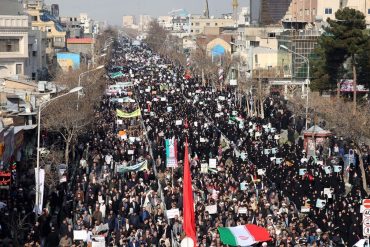
Iran is in the middle of one of the most violent waves of unrest it has seen in years. Anti government protests that began earlier this month have spread across the country and have been met by a fierce and often deadly response from security forces. Journalists, human rights groups, and families of those caught up in the violence say the scale of what is happening is unlike anything they have seen in a long time.
Iranian journalist Mohammad Reza Mousavi described what people inside Iran are experiencing in chilling terms. “The picture is really gruesome,” he told Newsmax. “Many people have been killed.” He said a friend in Iran told him that “walls are covered with obituaries of dead people, mostly young, who were killed in the recent protests.”
Even though the streets have been quieter in recent nights, Mousavi warned that the danger has not passed. “Within the past three nights, including tonight, there haven’t been much protests going on now,” he said. “But people are really worried.” He believes the pause will not last. “I don’t think it will be the end,” Mousavi said. “Even if the protests die down this time, I really expect another round of protests within the next months.”
A Growing Death Toll and Mass Arrests
Human rights groups say the crackdown has already claimed thousands of lives. The U.S. based Human Rights Activists News Agency reported that more than 2,400 protesters have been killed since the demonstrations began and that more than 18,000 people have been arrested. Other rights groups have suggested the true number may be higher, but Iran’s communications blackout has made independent verification difficult.
Amnesty International said it has gathered verified video, photographs, and eyewitness testimony showing what it called “mass unlawful killings” on an “unprecedented scale.” The group said Iranian security forces fired rifles and shotguns directly at unarmed protesters and bystanders, including from rooftops of residential buildings, police stations, and mosques.
“This spiral of bloodshed and impunity must end,” said Agnès Callamard, Amnesty International’s secretary general. She added that even by Iran’s own grim record, “the severity and scale of killings and repression since 8 January is unprecedented.”
CNN verified video from a makeshift mortuary near Tehran showing rows of black body bags with visible bullet wounds. Some bags were labeled with names and birth dates. One showed a birth year indicating the victim was just 16.
Actions Taken by the Government Against Protesters
The Iranian government has moved aggressively to crush the protests using arrests, threats of execution, surveillance, and information control.
Thousands of arrests have been carried out. According to the Human Rights Activists News Agency, more than 18,000 people have been detained since the unrest began. Many of them are being held without transparent legal proceedings.
The judiciary has warned of rapid trials and harsh punishment. Mousavi said the chief justice has threatened “quick trials,” which he believes “probably means summary executions.”
State media has aired warnings from the head of the judiciary that protesters who have been arrested will be dealt with swiftly, raising fears that death sentences could follow.
The Islamic Revolutionary Guard Corps has encouraged citizens to report suspected protesters through a special hotline. The IRGC said it received nearly 400,000 reports of “security violations,” which led to arrests.
The government has imposed a near total internet blackout. Cybersecurity watchdog NetBlocks said Iran has been under a blackout for days, preventing people from sharing information and making it difficult to verify the number of people killed.
Security forces have used lethal force. Amnesty International and CNN verified footage shows security forces firing live ammunition at unarmed protesters and bystanders, including from rooftops.
Threats of Execution Add to the Fear
The case of Erfan Soltani has become a symbol of the danger facing detainees. Soltani, a 26 year old arrested in Fardis, was told his execution would take place Wednesday, according to the Hengaw Organization for Human Rights and a family member. Later, the family was told the execution was postponed, but not canceled.
A relative pleaded publicly for help, saying, “I beg you, please do not let Erfan be executed.”
Experts told CNN that rushed trials and death sentences are a common tool used by the Iranian system during periods of unrest.
Iran’s leadership has rejected the claims of mass killings and executions and instead blamed foreign forces for the violence.
Foreign Minister Abbas Araghchi said on Fox News that reports of thousands of protesters being killed were part of a “misinformation campaign.” He said the real death toll was in the hundreds.
He claimed that after an initial period of peaceful protests, “we had a completely different story, a terrorist operation,” which he said was driven by foreign backed groups.
Araghchi also denied that protesters were being executed, saying that hanging them was “out of the question.”
At the same time, Iran’s Islamic Revolutionary Guard Corps accused the United States and Israel of being behind the unrest. Its commander said those responsible would receive a response “at an appropriate time.”
A Nation That May Not Return to Normal
Mousavi believes the emotional damage inside Iran is now too deep for things to simply go back to the way they were. “Many people have lost somebody dear to them, and this hatred and anger among them is increasing by the day,” he said.
“I don’t really think anything will go back to normal from this point,” Mousavi added.
With thousands dead, tens of thousands arrested, and a government relying on force and fear to maintain control, Iran now stands at one of the most dangerous moments in its modern history.
NP Editor: This is a brutal situation, and the government of Iran will have no support from its friends Russia and China. 47 years of radical, totalitarian, oppressive rule, may be coming to an end.