


As 2025 comes to a close, the 2028 presidential race is already taking shape, even though no one has officially declared. President Donald Trump cannot run again, but his presence still dominates both parties. Democrats see him as a threat to defeat and a foil to define themselves against. Republicans see him as a kingmaker who will bless or block their ambitions.
Behind the scenes, book tours, podcast appearances, travel to early primary states and high profile fights with Trump are all early campaign moves, just without the formal announcement.
The Overall Mood: Long, Crowded, And Very Personal
On the Democratic side, the mood has shifted from panic to tense optimism. After some better than expected results in 2025, many Democrats believe Trump’s support is slowly eroding. At the same time, they face a rare situation with no clear heir. Unless Kamala Harris runs again, there is no obvious “anchor” candidate. That means a true free for all, the first wide open primary of this kind since 1988.
Because the field is so open, potential candidates are far less coy than in past cycles. Some are now willing to say out loud that they are thinking about running, instead of hiding behind vague talk of “focusing on my job.” Voters are demanding “authenticity,” and the old habit of dodging every question about ambition now looks fake rather than humble.
On the Republican side, the mood is more cautious. Trump still controls the party, praises some would be successors and punishes others. Most serious Republicans are moving carefully, trying to stay in his good graces while quietly preparing for the moment he steps off the ballot.
How Trump Still Dominates Both Parties
Even when he is not on the ballot, Trump shapes the 2028 race.
For Democrats, the fastest way to get national attention is to confront him directly or block his policies. California Governor Gavin Newsom used a ballot initiative to suspend his state’s independent redistricting commission and redraw maps to favor Democrats, openly presenting this as a counter punch to Republican gerrymandering that helped Trump. Illinois Governor JB Pritzker has compared Trump’s “authoritarian playbook” to the early days of the Third Reich and has fought his attempts to send federal forces into Chicago.
Other Democrats are trying to position themselves as the best messenger against Trumpism. Josh Shapiro in Pennsylvania wants to show he can win a Trump state by big margins. Arizona Senators Ruben Gallego and Mark Kelly are using their own battles with the administration to show they can stand up to Trump on immigration, the military, and democracy.
For Republicans, Trump is the gatekeeper. He has publicly mused about the 2028 primary, praising his vice president JD Vance and Secretary of State Marco Rubio, and suggesting that the two of them together might be “unstoppable.” His endorsement still matters deeply, and losing his favor can be politically deadly. When Marjorie Taylor Greene questioned whether Trump was truly living up to “America First,” he called her a “traitor” and pulled his endorsement. Within a week she resigned from Congress.
Even in resignation, she is trying to occupy ideological territory that claims to be more America First than Trump himself. That shows how deeply his brand defines the right, even for his critics.
Democrats: A Deep Bench And No Clear Boss
The Democratic field is large, but most conversations start with five names who appear to be the most serious prospects right now.
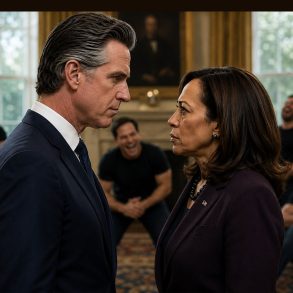
Gavin Newsom is the closest thing Democrats have to a frontrunner. Term limited in California at the end of 2026, he will soon be out of a job, and many assume his next full time role will be running for president. In 2025 he threw himself into fights with Trump, from resisting National Guard and ICE deployments in Los Angeles to spearheading a California redistricting initiative that added several Democratic seats. He is also aggressively present on social media, often satirizing Trump in ways that thrill liberal activists. Polls show him gaining steady ground and often leading the early field.
Kamala Harris is trying not to fade away. After losing as the Democratic nominee in 2024, she spent 2025 on a highly successful book tour for her campaign memoir. The book sold hundreds of thousands of copies, and her events packed venues across the country. She has chosen not to run for governor of California, signaling that she is keeping national options open. But her standing in early 2028 polling has slipped, and history is against her. Other than Trump, no modern politician has come back to win a nomination after already losing as the nominee. Harris is determined to stay in the conversation, but it is not clear that voters want another run.
Pete Buttigieg is also in the mix, though from a much weaker position. He no longer holds national office and has no governing platform that naturally puts him in daily conflict with Trump. His strength has always been his communication skills, so he is leaning into that, doing rallies, writing essays, and appearing on television and podcasts. He was once the “fresh face” in a field of older candidates. In 2028 he will be competing against a whole generation of younger, high profile Democrats. He has fans, but he still has very limited support among Black and Latino voters, which is a fatal weakness in a Democratic primary if he cannot fix it.
JB Pritzker offers a different path: the billionaire populist from the left. He has spent 2025 attacking Trump in stark moral terms and using his office and legal power to block parts of the Trump agenda, especially on immigration and federal deployments. Other Democratic leaders call him for advice on how to fight Trump, which shows how he has become an internal strategist as well as a public critic. He is publicly coy about his timeline, but no one doubts he is thinking about 2028. His ability to self fund a campaign only adds to his credibility as a serious contender.
Josh Shapiro represents the moderate, blue collar friendly wing of the party that once belonged to Joe Biden. He is a Democrat who has won huge vote totals in Pennsylvania, a state both parties view as crucial. Shapiro is up for reelection in 2026 and is expected to run again, in part because another big victory would make his electability argument undeniable. For now he deflects questions about the presidency, but he also talks about how “you cannot walk away now” with so much at stake. Even his Republican rivals accuse him of being more interested in Pennsylvania Avenue than Pennsylvania, which is a backhanded acknowledgment of his national ambitions.
Around these five, other Democrats are also circling. Alexandria Ocasio Cortez could inherit the Bernie Sanders wing if she runs, or leave it up for grabs if she chooses a Senate primary against Chuck Schumer instead. Ruben Gallego and Mark Kelly are building profiles with Latino outreach and clashes with Trump’s Pentagon. Andy Beshear is proving that a Democrat can still win twice in a deep red state like Kentucky. Chris Murphy and Cory Booker are testing messages in New Hampshire. Altogether, Democrats have a deep bench, but no clear leader.
Republicans: The Search For A Post Trump Standard Bearer
Republicans are in a very different situation. Their voters are not looking for a fresh start from Trumpism so much as a successor who will either continue or gently update it.
At the center is Vice President JD Vance. As Trump’s running mate and now vice president, he has the classic heir apparent position. Every Republican primary poll this year shows him in a commanding lead for 2028, often near or above 50 percent, even when Trump’s son is added to the list. Vance has embraced Trump’s confrontational style, attacking foreign leaders like Volodymyr Zelenskyy, telling his own wife to convert religions in public, and declaring that under Trump, white Americans do not need to apologize for being white. The result is a profile that thrills the hard core base and leaves much of the broader electorate cold. His favorability numbers among the general public are underwater, which would make him a risky nominee if Republicans decide electability matters more than ideological purity.
Marco Rubio has taken a very different path. A decade ago, he mocked Trump and warned that he was a con artist. Today he serves as Trump’s Secretary of State, advancing an America First foreign policy that does not always match his earlier hawkish instincts. Trump has publicly suggested that Rubio could be the next president, and Rubio has told confidants that he would support Vance in 2028, which sounds very much like someone auditioning to be a running mate. At the same time, some America First activists suspect that Rubio has not fully converted and still leans toward traditional conservative internationalism. If the base turns against global engagement once again, that suspicion could weigh him down.
Marjorie Taylor Greene is trying an even riskier move: separating America First from Trump himself. After questioning whether Trump still truly represents that label, she lost his endorsement and quickly resigned from Congress. She says she has no plans to run for president, and she has ruled out gubernatorial or Senate races in the near term. Yet she is suddenly everywhere in the media and has defined herself as “America First” rather than “MAGA.” If Republican voters stay loyal to Trump, she will look like a cautionary tale. If they sour on him after a bad midterm year, she could present herself as the one who dared to break with him first.
Other Republicans are in the wings. Utah Governor Spencer Cox is crafting a brand based on civility and a rejection of rage politics. Ted Cruz is trying to pull the party back to a hawkish foreign policy and attract donors through his popular podcast. Governors like Ron DeSantis, Brian Kemp, Sarah Huckabee Sanders and Glenn Youngkin have mostly fallen quiet, weighed down by scandals, past disappointments, or lack of connection to the current Trump centered party mood.
The 2026 Midterms: Dress Rehearsal For 2028
Everyone knows that 2026 will be a crucial testing ground. The midterms will show how strong Trump still is, how well Democrats can mobilize, and which potential 2028 candidates can actually help other people win races.
Newsom will point to the extra House seats he created through his redistricting gambit. Kelly and Gallego will try to flip swing districts in Arizona. Shapiro will aim to drag more Democrats over the finish line in Pennsylvania. Governors like Beshear will use their role in the Democratic Governors Association to claim credit for victories around the map.
At the same time, candidates will quietly test their own national messages, especially in early primary states like New Hampshire. Voters there will see a parade of senators and governors “helping” local candidates while really auditioning for a much bigger stage.
By early 2027, if Trump has a rough midterm and his support truly erodes, Democrats will be eager to rush into a primary that they think they can win. If Republicans feel that Trumpism has become a liability, they might look more seriously at alternatives who promise less chaos and more stability.
For now, the race is unofficial. But anyone watching closely can see the outlines of 2028 already coming into view.
Quick Look At The Top Contenders
Democrats
Gavin Newsom: Term limited Californian brawler, openly thinking 2028, early Democratic poll frontrunner.
Kamala Harris: Expanding memoir tour, keeping options open, but sliding polls make comeback uncertain.
Pete Buttigieg: Jobless communicator, building profile through speeches and media, needs broader coalition.
JB Pritzker: Billionaire governor, aggressively battling Trump, clearly interested yet publicly coy about 2028.
Josh Shapiro: Pennsylvania vote machine, focused on 2026 reelection while quietly auditioning for 2028.
Republicans
JD Vance: Trump heir apparent, leading GOP polls, confrontational style risks alienating general electorate.
Marco Rubio: Loyal Trump diplomat, influential yet torn between America First base and hawkish instincts.
Marjorie Taylor Greene: Resigned Congress, denies presidential plans, positioning as pure America First alternative.