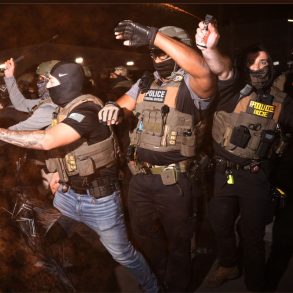



Roughly 70 percent of the illegal immigrants arrested by U.S. Immigration and Customs Enforcement under President Donald Trump have criminal ties. That single number sits at the center of a fierce political fight over immigration enforcement, public safety, and what it means for an arrest to involve a “criminal.”
The underlying data tell a much more detailed story than many headlines suggest. When you pull it all together, the picture that emerges is not of random roundups, but of a system that is hitting its criminal targets at a very high rate under difficult circumstances.
How Many People ICE Is Arresting And Deporting
New data from the Department of Homeland Security show that between Jan. 20 and Dec. 11 the Trump administration arrested about 595,000 illegal immigrants. ICE says roughly 70 percent of them, about 416,000 people, had criminal convictions or pending criminal charges in the United States.
Homeland Security Secretary Kristi Noem added another important layer. She announced that at least 515,000 illegal immigrants had been arrested and deported since January, and said that 70 percent of those deportees also had pending or criminal charges against them. On top of that, she said 1.6 million illegal immigrants have self deported under Trump rather than wait to be arrested.
Trump and Vice President JD Vance estimate that there are between 500,000 and 1 million criminal illegal immigrants still in the United States, and that about 1.5 million people have final deportation orders but have not yet been removed. The administration has responded with a massive enforcement buildup. A new spending package gives ICE and Border Patrol 170 billion dollars in additional funds through September 2029, which will pay for thousands more agents, more detention space, and an expansion of workplace and interior raids. White House border czar Tom Homan says arrest and deportation numbers will “explode greatly” in 2026.
What Homeland Security Means By “Criminal Ties”
When ICE and DHS say that 70 percent of those arrested have criminal ties, they are not talking only about people already convicted of violent felonies in the United States. Their definition includes two major categories.
First, it counts people with criminal convictions in U.S. courts. Second, it includes people with pending criminal charges who have not yet gone to trial or been sentenced. ICE argues that this is a reasonable way to measure risk, because many of those arrested are already in the criminal justice system, even if their cases are still moving through the courts.
ICE also says that the 70 percent figure is conservative because it does not count a large group of foreign public safety threats. An agency spokesperson noted that the statistic does not include “those wanted for violent crimes in their home country or another country, INTERPOL notices, human rights abusers, gang members, terrorists.” In other words, if an illegal immigrant has a clean record in U.S. databases but is wanted abroad, that person does not show up in the 70 percent number, even though the public safety concern is obvious.
The agency points to cases to illustrate this. One example is Antonio Israel Lazo Quintanilla, who was picked up in the United States for driving without a license, but was wanted in El Salvador for aggravated homicide, extortion, drug possession, and other felonies. Another is Akhror Bozorov, a citizen of Uzbekistan with no U.S. criminal record, who was wanted at home for alleged involvement with a terrorist organization. These are the kinds of foreign fugitives who do not show up in the 70 percent statistic, but still pose serious risks.
ICE officials also stress that simply being present in the country illegally is not a harmless technicality. They argue that ignoring immigration court orders and remaining in the United States illegally places extra burdens on law enforcement, schools, and taxpayers.
A Closer Look At The Numbers Behind The 70 Percent
The 70 percent figure shows up in several different data sets and time frames.
One set of numbers comes from internal ICE data covering Jan. 21 to Oct. 15. The Deportation Data Project, which obtained the data through a lawsuit, reports a total of 220,802 arrests in that period. According to their breakdown, 36.5 percent of those arrested had criminal convictions and 29.8 percent had pending criminal charges. Together, that means about 66.3 percent had some kind of criminal case in the United States. DHS has responded by rounding that up and saying “70 percent” of arrests are of illegal immigrants charged or convicted of a crime.
Other internal snapshots tell a similar story. Between February and April, roughly 75 percent of those arrested had criminal records. By May, that share dipped to just over 67 percent after ICE was directed to expand operations to courthouses and workplaces, including farms and retail hubs, where officers naturally encounter more people without prior arrests. Even as the mission broadened, the percentage with criminal records or charges remained roughly two thirds or higher.
Noem’s figure that “70 percent” of 515,000 deportees have pending or criminal charges fits the same pattern. Across different months, data sources, and enforcement programs, the share of people with criminal ties in ICE’s caseload keeps clustering near that level.
The Critics Focus On A Different Slice Of The Data
Opponents of Trump’s enforcement strategy tell a very different story, but they get there by looking at different slices of the same data and by redefining what counts as a “criminal.”
Media reports based on the Deportation Data Project highlight that nearly 75,000 of the 220,802 people arrested between Jan. 21 and Oct. 15 had no prior criminal convictions. That is about one third of all arrests. Headlines emphasize that “more than a third” of ICE arrestees have no criminal histories, and that this “contradicts what the administration has been saying about people who are convicted criminals and that they are going after the worst of the worst,” as analyst Ariel Ruiz Soto put it.
The same data has been used to argue that ICE is sweeping up mostly non criminals in particular regions. One New York Times analysis cited by the project found that about 67.5 percent of those arrested in targeted operations in Los Angeles, Washington, D.C., Massachusetts, and Illinois had no prior criminal background. That local view looks very different from the national 70 percent figure that counts all arrests and includes pending charges.
In Chicago, a Department of Justice document filed in federal court shows 614 immigrants arrested in recent raids under “Operation Midway Blitz.” Of those, 598 had no criminal record. Only 16 people, or 2.6 percent, had a criminal record. None of them were convicted or arrested for murder or rape. Most had low or medium risk ratings if released. Lawyers for the migrants say the list proves that ICE conducted a broad sweep of anyone it could find, not a targeted search for violent criminals.
Civil liberties groups argue that such raids may violate a 2022 consent decree that placed strict limits on arrests without warrants or probable cause. Michelle Garcia of the ACLU of Illinois says that “it is very clear they just did a broad sweep of anybody and not a targeted sweep of people who were here unlawfully and that they knew were likely to flee or were criminals as they lead you to believe.”
Critics also question the way DHS counts people with pending charges. Cato Institute scholar David Bier notes that only about 5 percent of people booked into ICE facilities had a violent crime conviction, while 73 percent had no prior convictions or only pending charges. He argues that DHS inflates its numbers by counting people with pending charges as “criminal arrests” even though many of those charges are minor and often dismissed. In his view, ICE is depriving people of due process by arresting them before any conviction.
How The Administration Responds To Media Narratives
Officials inside DHS and the Trump administration say the media is cherry picking data and ignoring the full national picture.
DHS Assistant Secretary Tricia McLaughlin responds to stories about large numbers of non criminal arrests by repeating the nationwide statistic. “Seventy percent of illegal aliens ICE arrested across the country have criminal convictions or pending criminal charges just in the U.S.,” she said, calling criticism of ICE’s focus “basic math” that leaves out thousands of cases in other regions and categories.
The department has also tried to bypass media framing with its own messaging. In response to reports about deportations of people with no criminal records, DHS launched a “Worst of the Worst” webpage. The site profiles illegal immigrants with criminal backgrounds involving homicides, assaults, drug trafficking, and other serious offenses. McLaughlin says the page is meant to show that “our brave men and women of ICE risk their lives for the American people” and that Americans can see for themselves “what public safety threats were lurking in their neighborhoods and communities.”
Trump allies argue that critics deliberately blur the difference between illegal immigrants who have no U.S. convictions yet, those with minor offenses, and those who are wanted for serious crimes or who have already been ordered deported. They say that the 70 percent figure, which includes people with pending charges, is exactly the right measure for an agency that works inside the criminal justice system and that often receives leads from state and local police.
The enforcement battle is not only about statistics. It also plays out in cities, workplaces, and courts.
Noem has attacked sanctuary city politicians like Minneapolis Mayor Jacob Frey, arguing that their refusal to work with ICE allows dangerous criminals to live in communities “unchecked.” In September, the Department of Justice sued Minneapolis, St. Paul, and Hennepin County over sanctuary policies that allegedly interfere with federal immigration law. Attorney General Pam Bondi says such policies “result in the release of dangerous criminals” who would otherwise likely be deported. Assistant Attorney General Brett Shumate calls shielding illegal aliens from federal law enforcement a “blatant violation of the law” with “dangerous consequences.”
At the same time, there is clear evidence that the crackdown is being felt in the labor market. ICE arrest data show that about 90 percent of those arrested are male. Mexican nationals account for the largest share with about 85,000 arrests, followed by 31,000 from Guatemala and 24,000 from Honduras. More than 60 percent are between 25 and 45 years old. Those are prime working ages.
George Carrillo, head of the Hispanic Construction Council, says, “Now we are really feeling that pain in the workforce.” He supports securing the border but warns that enforcement is hitting companies that rely on migrant workers. According to him, even conservative Republicans now realize that “something different has to be done because now it is affecting their businesses.”
ICE field offices are also under strong political pressure to increase numbers. In mid May, White House deputy chief of staff Stephen Miller threatened to fire senior ICE officials if they did not arrest at least 3,000 migrants per day. In reality, the average has been 824 arrests per day since Jan. 20, more than double the 312 per day under the Biden administration in 2024, but still far below the internal goal.
Why A Seventy Percent Criminal Hit Rate Is Exceedingly High
When you put the data and the context together, the 70 percent number looks strong rather than weak.
ICE has only about 6,500 officers responsible for interior enforcement nationwide. The agency often has to rely on state and local police arrests, including routine traffic stops, to identify targets. In jurisdictions that refuse to honor ICE detainers, officers have to track people down in the community. That raises the odds of encountering family members, co workers, and others who may have no criminal record at all, yet are still in the country illegally.
Workplace raids and courthouse operations also have a similar effect. When ICE goes into farms, retail hubs, or city courts, its officers are pursuing specific targets, but they inevitably encounter many other undocumented migrants standing nearby. Some will have criminal records, others will not. This is why the share of arrestees with criminal records dropped from 75 percent to just over 67 percent once those operations expanded, even though enforcement overall stayed focused on public safety threats.
Given those realities, a national figure where about seven out of ten ICE arrestees have criminal convictions or pending charges in the United States is an exceedingly good hit rate. It means that even in complex, messy operations, the great majority of people arrested already have some kind of documented criminal involvement. The number does not even count foreign fugitives, gang members, or suspected terrorists whose records sit in other countries.
Critics can point to specific operations, like the Chicago raids where 97 percent reportedly had no criminal record, or to regions where two thirds of arrests involve people without convictions. Those are important pieces of the story. Yet they do not erase the broader reality that nationally, ICE is repeatedly arresting people with criminal ties in large numbers, just as Trump promised when he vowed to “return millions and millions of criminal aliens back to the places from which they came.”
The debate over ICE statistics is really a debate over priorities and definitions. The Trump administration and DHS count both convictions and pending charges when they say “70 percent,” and they emphasize the hidden category of foreign criminals and fugitives who do not show up in that statistic. They see illegal presence, especially after a court order, as a serious offense that puts pressure on schools, hospitals, and law enforcement.
Media outlets and advocacy groups often narrow the focus to those with no convictions, or to a handful of cities, in order to argue that the crackdown is sweeping up “hardworking people who have families and ties to this country,” as ACLU attorney Michelle Garcia says. Analysts like David Bier argue that including pending charges as “criminal arrests” abuses due process and inflates the danger.
With crime, fentanyl trafficking, and public safety ranking high in voter concerns, the Trump administration is betting that most Americans will side with the broader 70 percent view. The combination of hundreds of thousands of arrests, a large majority tied to criminal cases, and an even more aggressive push planned for 2026 is the core of that argument.
There is no question that the numbers are being used as political weapons. Yet when you look at the full picture, the claim that around 70 percent of ICE arrests involve people with criminal ties holds up across multiple data sets. In a hostile legal and political environment, with limited manpower and sanctuary policies in many cities, that level of targeting looks not like a failure, but like an enforcement machine that is working largely as promised.