

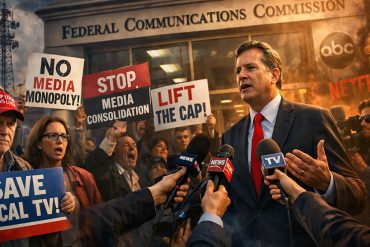
The Federal Communications Commission is facing intense pressure to reconsider one of the most important safeguards in American media policy, the national television ownership cap. This rule limits any single broadcast company from reaching more than 39 percent of U.S. television households. Supporters of the cap argue it exists for very good reasons, including competition, local accountability, and viewpoint diversity. Critics say it is outdated and unfair in a media world dominated by Big Tech and global streaming platforms.
As the FCC conducts its legally required quadrennial review of media ownership rules, the debate has exposed deep divisions not just between broadcasters and regulators, but within conservative media circles themselves.
What the 39 Percent Rule Is and Why It Was Created
The national television ownership cap was originally adopted during the Reagan administration as a conservative check on excessive consolidation. At the time, policymakers worried that allowing a few companies to dominate broadcast television would reduce competition and give too much editorial power to too few decision makers.
In 2004, Congress codified the cap into law, setting the limit at 39 percent of U.S. households. That decision came after bipartisan concern that earlier FCC efforts to raise the cap had gone too far. Lawmakers struck a compromise that allowed modest growth while still preventing any one company from dominating the national broadcast landscape.
The reasoning behind the cap was tied directly to the nature of broadcast television. Local stations operate on public airwaves. In exchange for access to that limited public spectrum, broadcasters are expected to serve local communities with news, public affairs programming, and emergency information. Congress believed that local accountability would weaken if ownership became too concentrated.
Crucially, Congress also excluded the national ownership cap from the FCC’s regular review authority, signaling that changes to this rule were meant to be decided by lawmakers, not regulators acting alone.
The current debate is unfolding under FCC Chairman Brendan Carr, who has argued that ownership rules no longer reflect modern media realities. Carr has called the cap an artificial limit that prevents broadcasters from competing with technology companies that face no similar restrictions.
Under the Telecommunications Act of 1996, the FCC is required to review media ownership rules every four years to determine whether they remain necessary in the public interest. As part of that process, the agency has asked for public comment on whether the 39 percent cap should be retained, modified, or eliminated.
That request has triggered a flood of filings from broadcasters, trade groups, conservative organizations, consumer advocates, and independent media outlets.
The Push to Loosen or Eliminate the Cap
Broadcasters and their allies argue that the media marketplace has changed beyond recognition since the cap was adopted. The National Association of Broadcasters has been one of the loudest voices calling for repeal, arguing that local stations are losing advertising revenue to companies like Google, Meta, Amazon, and Netflix.
In a joint filing, the NAB and a broad coalition of broadcasters wrote that the cap “unfairly prevents broadcasters from reaching more than 39 percent of the total number of TV households in the country.” NAB President and CEO Curtis LeGeyt said, “The message is clear: it is time to eliminate the outdated national TV ownership cap.”
LeGeyt argued that broadcasters need scale to survive, invest in journalism, and provide public safety information. The coalition claimed that “the public interest is best served by empowering broadcasters, not restraining them.”
Nexstar Media Group has made this argument central to its effort to acquire Tegna in a deal valued at more than $6 billion. Nexstar already owns or partners with more than 200 stations. Acquiring Tegna’s 64 stations would push its reach to more than 54 percent of U.S. households, well above the legal limit.
Nexstar said in a statement that “the landscape is ripe for regulatory reform” and argued that modernizing FCC rules would allow local broadcasters to compete on a level playing field with Big Tech. The company said Americans want “more access to local news and a variety of voices without the filter of the coastal elites.”
The Center for American Rights has also entered the fight, launching a website and paid advertising campaign urging repeal of the cap. CAR President Daniel Suhr said, “By giving regulatory relief to local broadcasters, we can empower local voices and support a stronger counterbalance to the national networks.”
Why Many Conservatives and Media Watchdogs Oppose Change
Opposition to loosening the cap has come from an unexpected mix of conservative organizations, independent media outlets, and consumer advocates. Chief among them is the Conservative Political Action Conference.
In a filing submitted by its Center for Regulatory Freedom, CPAC urged the FCC to preserve the cap and resist industry calls for consolidation. CPAC argued that deregulation would allow “a handful of companies owning almost all the major TV stations across the nation.”
CPAC wrote that “broadcast regulation exists not to manage markets or referee private negotiations, but to preserve localism, protect free speech, and ensure that the American people hear the widest possible range of voices in the marketplace of ideas.”
The organization stressed that local broadcast stations operate on public spectrum and must remain accountable to local audiences. CPAC warned that relaxing ownership limits would weaken that accountability and reduce the number of independent media voices.
Independent outlet Newsmax has taken a similar position. In its objections, Newsmax warned that lifting the cap could “stifle media diversity, diminish local news coverage, and consolidate political power over information distribution.”
Critics also emphasize the legal history of the rule. They argue that Congress deliberately removed the national cap from the FCC’s authority to revise during quadrennial reviews, meaning any change should come from lawmakers, not regulators.
Chris Ruddy and the Internal Conservative Clash
One of the most vocal opponents of lifting the cap is Chris Ruddy, the founder and CEO of Newsmax and a longtime ally of President Donald Trump. Ruddy has argued that removing the cap would harm conservatives by allowing large station groups to dominate local news nationwide.
According to reporting cited by President Trump, Ruddy said that “Reagan understood if you have left wing networks like ABC, NBC and CBS or groups like Nexstar today controlling every local station and their local news Republicans would have little chance to win in state and federal elections.”
Ruddy’s campaign has drawn sharp criticism from broadcasters and the NAB. NAB spokesperson Alex Siciliano said, “These outdated rules do not restrict networks, they restrict local stations that are trying to survive.”
Siciliano also accused Ruddy of running a misleading campaign, saying it was “about preventing those local broadcasters from competing on the same playing field as a station like his that already reaches 100 percent of the country.”
President Trump’s Complicated Position
President Trump has weighed in forcefully, saying he would oppose lifting the cap if it allowed what he calls fake news networks to expand. In a Truth Social post, Trump wrote, “If lifting the FCC’s 39 percent ownership cap would also allow the Radical Left Networks to enlarge, I would not be happy.”
He singled out ABC and NBC, writing that they are “a virtual arm of the Democrat Party” and adding, “NO EXPANSION OF THE FAKE NEWS NETWORKS. If anything, make them smaller.”
Trump’s stance puts him at odds with FCC Chairman Carr, despite Carr being his appointee. It also complicates the hopes of broadcasters who believed Trump’s return to office would guarantee deregulation.
Why Reluctance Remains Strong
Even acknowledging that the media landscape has changed dramatically since 2004, many critics remain reluctant to loosen the ownership cap. They argue that broadcast television remains uniquely powerful because it uses public airwaves and carries public interest obligations that streaming platforms do not.
Allowing a small number of companies to control most local stations risks reducing competition, weakening local journalism, and narrowing the range of viewpoints available to the public. Opponents warn that consolidation would not counter Big Tech’s power but would instead create another concentrated media structure.
As CPAC put it, “Ownership limits are not about punishing success or freezing markets in time. They aim to prevent excessive consolidation of editorial control that would narrow the range of viewpoints available to the public.”
From this perspective, competition remains a core conservative value. While technology evolves, the underlying principle that no single voice should dominate the public square remains as relevant as ever.
The Federal Communications Commission is facing intense pressure to reconsider one of the most important safeguards in American media policy, the national television ownership cap. This rule limits any single broadcast company from reaching more than 39 percent of U.S. television households. Supporters of the cap argue it exists for very good reasons, including competition, local accountability, and viewpoint diversity. Critics say it is outdated and unfair in a media world dominated by Big Tech and global streaming platforms.
As the FCC conducts its legally required quadrennial review of media ownership rules, the debate has exposed deep divisions not just between broadcasters and regulators, but within conservative media circles themselves.