A Dramatic Warning in the Skies
President Donald Trump made global headlines when he declared that the airspace above and around Venezuela was completely closed. He wrote, “To all Airlines, Pilots, Drug Dealers, and Human Traffickers, please consider THE AIRSPACE ABOVE AND SURROUNDING VENEZUELA TO BE CLOSED IN ITS ENTIRETY.” He ended the statement with, “Thank you for your attention to this matter. PRESIDENT DONALD J. TRUMP.”
This message came after U.S. aviation regulators warned about a “potentially hazardous situation” resulting from “worsening security” and “heightened military activity.” Venezuela responded by revoking operating rights for several major airlines. Closing another country’s airspace is widely seen as a major escalation and in some cases has been viewed as an act of war.
This airspace conflict reflects a larger crisis. Tensions between Washington and the Maduro regime have grown to the point where military confrontation is no longer a theoretical possibility but a genuine threat.
Venezuela’s Political Breakdown and a Desperate Population
Nicolás Maduro has held power since 2013. Under his rule, Venezuela has collapsed economically and socially. Food shortages, violent crackdowns, widespread poverty, and corruption have reshaped daily life. Many Venezuelans want change, and many hope for Maduro’s fall.
The United States recently designated Maduro as the leader of the “Cartel de los Soles,” a terrorist organization accused of drug trafficking. Maduro denies the charge and claims the U.S. wants to overthrow him to seize Venezuela’s oil. He said Venezuelans and the military will “resist any such attempt.”
The source material shows that Trump views Maduro as a criminal strongman who profits by sending drugs into the United States. The Trump administration argues that Venezuelan organized crime and the government are intertwined. Many Venezuelans agree, seeing Maduro as the center of a brutal system they want to escape.
Trump’s Expanding Operations Against Drug Traffickers
Trump has dramatically increased military actions aimed at alleged Venezuelan drug smugglers. Since September, U.S. forces have launched at least 21 strikes on boats near Venezuela, killing more than 80 people. Defense Secretary Pete Hegseth announced strikes on two additional vessels and said six people were killed for “alleged trafficking of narcotics.”
Some lawmakers, including Republicans, have questioned the legal basis for these attacks. The administration has pushed back by saying Congress has been “privy to what’s happening,” although Senator Jeanne Shaheen said the White House has “counted the same briefing multiple times,” implying Congress is not getting complete information.
Trump told U.S. service members that the United States would “very soon” begin land operations aimed at Venezuelan narcotics traffickers. He also authorized covert CIA activities inside Venezuela. These moves have raised fears that the mission is expanding from anti narcotics operations into a plan for regime change.
Trump and Maduro Speak, but Tensions Still Rise
Trump and Maduro held a private phone call, joined by Secretary of State Marco Rubio. Reports claim the President warned Maduro that military escalation would follow if he did not leave Caracas soon, though the White House denied that particular part as “fabricated.” Sources told The New York Times that the designation of Maduro as a terrorist leader added pressure to that conversation.
Although some reports claimed Maduro and Trump discussed a possible meeting, the White House again called that “fabricated.”
The call took place while the U.S. was building a major military presence in the Caribbean. Analysts note that U.S. actions no longer resemble normal counter drug operations. Instead, as the Center for Strategic and International Studies put it, the deployment “has the hallmarks of a force positioned for sustained strike operations.”
According to Reuters, Venezuela’s military is overwhelmed by low pay, failing equipment, and widespread desertions. One source said rank and file soldiers earn only about 100 dollars a month, far below the amount needed for a family to survive. Much of the military’s recent experience has been used for “confronting unarmed civilians,” not resisting a foreign invasion.
Maduro claims that 8 million civilians are training as militia members. However, sources say only a few thousand loyal supporters and intelligence personnel would likely participate in real fighting.
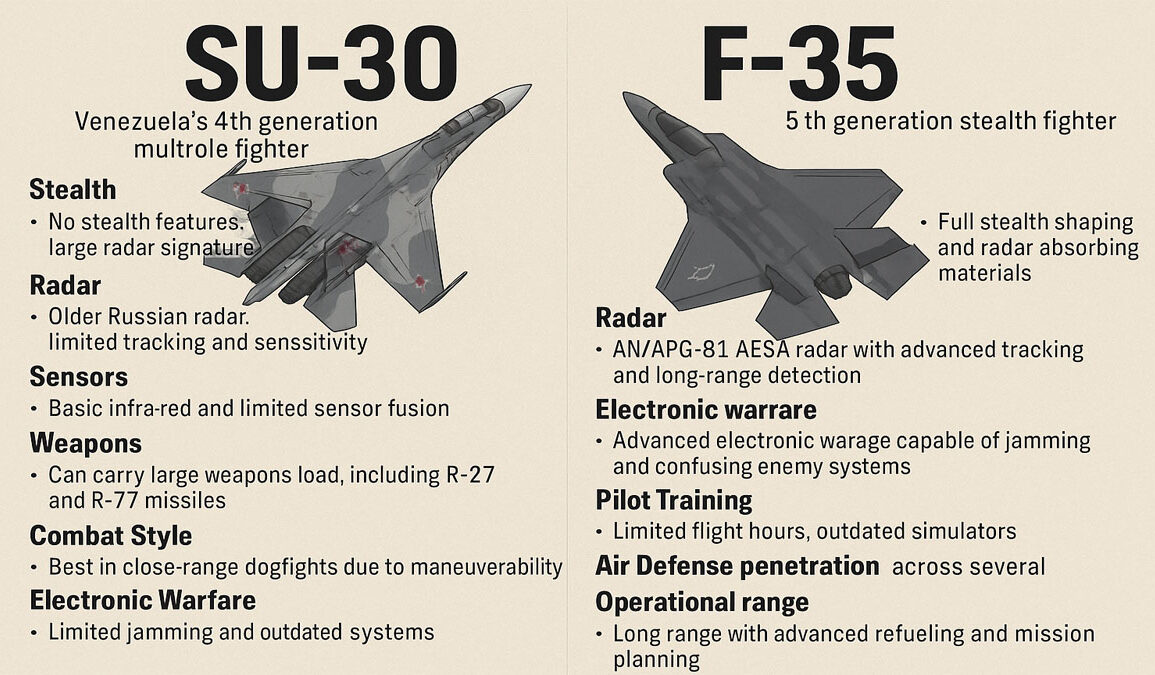
Venezuela also has old Russian equipment. They possess Su-30 fighter jets, Russian made helicopters, tanks, and shoulder fired missiles, but many are outdated and in poor condition. Their air defense systems include Buk-M2 systems and S-300 systems, but experts question the condition and readiness of these platforms.
How Venezuela Plans to Fight
Reuters reports that Venezuela’s strategy for resisting a U.S. attack is called “prolonged resistance.” This would involve small units operating from more than 280 locations, carrying out sabotage and guerrilla attacks.
A second strategy, which sources say the government has not publicly acknowledged, is called “anarchization.” Intelligence services and pro government armed groups would create chaos inside Caracas to make the country ungovernable for any invading force.
Colectivos, which are ruling party supporters who often ride motorcycles and carry weapons, would likely play a role. Colombia based guerrillas are also active in western Venezuela, adding another layer of complexity to any conflict.
What a U.S. Venezuela War Could Look Like
Analysts agree that the United States would quickly achieve air and sea dominance. Retired Marine Colonel Mark Cancian said the military posture has changed, noting that U.S. forces now include assets that are “plenty adequate” for long range strikes. Retired Admiral James Stavridis said the objective is to convince Maduro that “his days are numbered.”
The United States has deployed:
- the USS Gerald R. Ford, the world’s largest aircraft carrier
- guided missile destroyers
- an amphibious ready group
- special operations support vessels
- at least one nuclear powered submarine
- at least ten F 35B stealth fighters in Puerto Rico
CSIS analysts estimate that U.S. forces have access to around 170 Tomahawk missiles, similar to the arsenal used in Libya in 2011.
Cancian said the administration might be hoping for the regime to collapse from internal pressure. “I have heard the theory that the administration is hoping for the regime to disintegrate so that we could come in and pick up the pieces,” he said.
John Erath from the Center for Arms Control said the deployment has “no military justification” if the mission is simply counter drug operations. He said the U.S. carrier presence is “just a show of force” and that the amount of force in the region is “well in excess of anything reasonable.”
Risks and Consequences
Experts warn that even a limited conflict could have unpredictable results. Cancian warned that Venezuela could become a failed state, leading to deeper chaos and new cartel power struggles. He also said the cartels might retaliate, including attacks on U.S. personnel. He gave one scenario: “You could imagine that if there were an incident where three or four DEA agents were gunned down by cartel hitmen. That would change the complexion of the operation.”
Erath questioned whether the operation violates international law and said the strategy lacks clarity. He said, “The whole thing does not make a whole lot of sense.”
How the Venezuelan Regime Is Preparing
Venezuela is carrying out nationwide drills to show readiness. Fighter jets flew low over cities. Air defense radars were deployed. Missile systems were displayed and cleaned for public videos. Concrete obstacles have been installed along the highway leading into Caracas to slow any invading vehicles.
Militia recruitment has intensified. Even though the official militia numbers may be exaggerated, the government is trying to show that Venezuelan society will fight.
CNN reports that Venezuela is preparing for “every possibility.” One expert said this could become “an existential fight for Maduro’s regime.”
A Nation Hoping for Freedom
While the Venezuelan regime prepares for a confrontation, millions of ordinary Venezuelans quietly hope for a different outcome. After years of hardship and authoritarian rule, many want Maduro gone. They also want an end to the drug trafficking networks that have corrupted the nation and harmed families in both Venezuela and the United States.
Trump’s stance reflects the belief held by many Venezuelans that their nation is ruled by a cruel dictatorship enriched by narcotics and political repression. If Maduro were removed, it is likely that many Venezuelan citizens would see it as the first step toward rebuilding their country.
President Trump said he doubts a war is imminent but warned that Maduro’s days “are numbered.” CSIS summed up the situation by saying the United States is like “an archer with an arrow drawn.” The region now sits in a tense and unstable moment where a single decision from Washington or Caracas could determine whether peace holds or a conflict begins.