

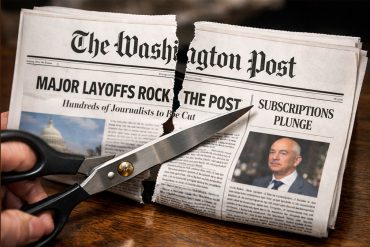
The Washington Post is undergoing one of the largest layoffs in its history, cutting roughly a third of its staff in what executives describe as a painful but necessary restructuring. More than 300 journalists are losing their jobs, along with additional employees on the business side, shrinking an institution that once portrayed itself as indispensable to American democracy.
The cuts hit at the core of the paper’s operations and mark a dramatic reversal for a newsroom that spent years expanding while aggressively attacking conservatives and Republican administrations.
The Washington Post is owned by Jeff Bezos, the Amazon founder and one of the wealthiest people in the world. Bezos purchased the paper in 2013 for $250 million and initially positioned himself as a savior of legacy journalism.
While Bezos has not publicly commented in detail on the layoffs, responsibility for the restructuring has been placed squarely on newsroom leadership. Matt Murray, the paper’s executive editor, told staff that the organization had been losing too much money for too long and was failing to meet readers’ needs.
“We are losing large amounts of money,” Murray previously warned staff. “Your audience has halved in recent years. People are not reading your stuff.”
According to people with direct knowledge of the decision, the Post laid off more than 300 journalists out of a newsroom of roughly 800. Overall, about 30 percent of the company’s total workforce has been eliminated.
Employees began receiving emails informing them their jobs had been “eliminated,” a word that spread rapidly through internal messages as stunned journalists notified one another in real time.
Which Departments Are Being Cut
The layoffs cut deeply into several of the Post’s most visible sections.
The sports department is being shut down in its current form, ending what had long been one of the paper’s most recognizable sections. Some sports reporters will be reassigned to the features desk to cover sports as culture rather than competition.
Local and metro coverage is being sharply reduced, making the paper far less focused on Washington, D.C., and its surrounding communities. International reporting has also been slashed, with reporters laid off in regions including the Middle East, India, and Australia. The books section is closing entirely, and the daily “Post Reports” podcast has been eliminated. All staff photographers were cut, even as the paper continues to publish visually driven stories.
Murray told employees the revamped Post would now focus on national politics, business, health, and major investigations, abandoning many of the areas that once gave the paper its breadth.
Why the Layoffs Are Happening
Post leadership cites financial pressure as the central reason for the cuts. Digital subscriptions have declined, advertising revenue has sagged, and online search traffic has dropped by nearly half in the last three years. Murray also pointed to the rise of generative artificial intelligence as a major factor disrupting traffic and reader habits.
The paper’s daily story output has fallen significantly over the past five years, and leadership concluded that the organization was “too rooted in a different era” when it functioned as a dominant local print product.
In late 2023, Bezos hired publisher Will Lewis to find a path to profitability. Lewis pushed newsroom changes, embraced artificial intelligence tools, and ended presidential endorsements, including blocking a drafted endorsement of then Vice President Kamala Harris. That decision triggered a wave of cancellations from liberal readers, worsening the paper’s financial problems.
Democrats React With Outrage
Prominent Democrats quickly blamed Bezos for the cuts, framing them as an attack on accountability journalism.
Elizabeth Warren wrote on social media, “Jeff Bezos just fired hundreds of reporters at the Washington Post, including the Amazon reporter holding his own company accountable.” She added pointedly, “Reminder: Jeff Bezos’ net worth is nearly $250,000,000,000.”
Chris Van Hollen called the layoffs “a devastating day for the paper of record in our nation’s capital,” accusing Bezos of misplaced priorities. “Bezos just spent $40M sucking up to Trump with Amazon’s ‘Melania,’ but is now cutting a third of staff for budget reasons,” he wrote.
Mark Warner echoed the criticism, saying, “We need tough, fair, independent reporting at home and abroad in order to keep our democracy. What a disappointing day.”
What Insiders and Media Figures Are Saying
Current and former Post journalists described the layoffs in bleak terms. Jeff Stein, the paper’s chief economics correspondent, called it “a tragic day for American journalism,” adding that laid off reporters were “being punished for mistakes they did not cause.”
Former executive editor Marty Baron said the cuts ranked “among the darkest days in the history of one of the world’s greatest news organizations,” warning that the public would be denied ground level reporting.
Don Graham, whose family owned the Post for decades before selling to Bezos, said he would “have to learn a new way to read the paper,” noting that he had started with the sports page since the 1940s.
Outsiders Offer Sharper Theories
Commentators outside the Post offered less sympathetic interpretations.
Slate writer Alex Kirshner argued that the layoffs were not just about economics but about Bezos’ personal incentives. He wrote that Bezos “wanted the Post to die, because a vigorous, well resourced newspaper does not suit his vision for the world or his own bottom line.” Kirshner argued that a paper willing to aggressively challenge political power was more trouble than it was worth to a billionaire with vast corporate interests.
Others pointed to years of ideological overreach. Critics argue that the Post spent the Trump years relentlessly attacking conservatives, often with open hostility, while assuming a permanent liberal subscriber base that would never leave. When endorsements were halted and the paper tried to pivot, that audience disappeared, and there was no replacement waiting in the wings.
As one Washington Post insider told Fox News Digital, “This is the end of the institution. They’ve lost the trust of the newsroom. Anyone who wasn’t laid off today will be looking for a new job.”
A Shrinking Bastion of Liberal Media
For decades, the Washington Post positioned itself as a moral authority and a watchdog of conservative power, frequently carrying water for Democratic priorities while treating Republicans as presumptive villains. That approach won awards and applause inside media circles, but it also narrowed the paper’s appeal and hardened its reputation as an ideological actor rather than a broad public service.
Now, the institution that once claimed to speak for democracy is shrinking dramatically, abandoning local communities, international reporting, and even entire sections of its newsroom. While Democrats mourn the losses, critics see something else: a powerful liberal media outlet finally confronting the economic reality of alienating half the country.
The Washington Post will continue publishing, but with fewer voices, fewer perspectives, and far less reach. For those who felt targeted by its coverage for years, the contraction is not a tragedy. It is a reckoning.
NP Editor: I cannot say I am sad to see the Washington Post shrink and lose popularity. As important as some may feel they have been, I can’t help but wonder if they have done more harm than good. And I can’t help hoping that Bezos will buy the New York Times…
And I also don’t see the wisdom of cutting local features and area focus since this may be its only unique content. Lots of folks cover national issues.